Best Towns in Aysen for Families: Schools, Healthcare and Real Life
TL;DR If you are moving to Aysen with kids, the honest answer is that Coyhaique wins on options and loses on air. It has 41 schools, the region’s only high-complexity hospital and the only university, but winter wood smoke is a genuine health issue. Puerto Aysen is the balanced middle: 19 schools, a new medium-complexity hospital, about an hour from the capital, and a lot more rain. Chile Chico gives you sun, orchards and small classes, at the cost of distance. Cochrane is for families who want the frontier and can plan around a four-hour drive to specialist care. Pick by the age of your youngest child, not by the view.
Family life in Aysen starts with picking the right town. Browse houses for sale in Coyhaique.
Every family that contacts us about Chilean Patagonia asks the same three questions, usually in the same order. Where will the kids go to school? What happens if someone gets seriously sick? And can we actually live here in July, or is this a summer fantasy?
Those are the right questions, and they have real answers. This guide compares the four towns in the Aysen Region where a family can realistically build a life: Coyhaique, Puerto Aysen, Chile Chico and Cochrane. We use public data on schools, enrollment, standardized test results and health infrastructure, then we tell you what the numbers leave out.
Fair warning: nothing here will tell you that all four are equally good. They are not. They are good at very different things.
The one number that frames everything
Aysen is the only region in Chile that lost population in the last census. It went from 103,158 inhabitants in 2017 to 100,745 in 2024, a drop of 2.4 percent. Households shrank too: the regional average went from 3.7 people in 1992 to 2.5 in 2024, the smallest in the country.
Read that carefully, because it cuts both ways for a family. On the downside, it means a shrinking pool of young families, smaller cohorts moving through the school system, and rural schools that quietly close. On the upside, it means small classes, teachers who know your kid’s name, housing that has not been bid up by population pressure, and communities that genuinely welcome new families because they need them.
Population is also wildly concentrated. Coyhaique holds 57.4 percent of the region’s people and Aysen commune another 23 percent. Everything south of Cerro Castillo is a rounding error demographically, which is exactly why it is so beautiful and exactly why it is harder with children.
Numbers That Matter: Four out of five people in Aysen live in either Coyhaique or Puerto Aysen. If your shortlist is entirely south of Cerro Castillo, you are choosing a lifestyle first and a service level second. That is a legitimate choice, but make it on purpose.
The four towns at a glance
| Coyhaique | Puerto Aysen | Chile Chico | Cochrane | |
|---|---|---|---|---|
| Population (2024 projection) | 62,046 | 25,218 | 5,163 | 3,741 |
| Schools | 41 | 19 | 5 | 2 |
| School enrollment | 13,698 | 5,636 | 908 | 807 |
| Private paid schools | 1 | 0 | 0 | 0 |
| Hospital level | High complexity | Medium complexity | Low complexity | Low complexity |
| Health facilities in commune | 29 | 10 | 4 | 1 |
| Drive to high-complexity care | 0 min | ~1 hr | ~5 hr | ~4.5 hr |
Sources: BCN Reporte Comunal Coyhaique, Aysen, Chile Chico and Cochrane, Biblioteca del Congreso Nacional.
Coyhaique: everything you need, plus the smoke
Coyhaique is the regional capital and it is not close. With 62,046 residents and 41 educational establishments serving 13,698 students, it is the only place in the region where you get a genuine choice of school: 17 municipal, 22 subsidized private, one fully private paid, plus a corporatized technical center.
That choice matters more than people expect. In a town with two schools, you take what you get. In Coyhaique you can pick between religious and secular, technical and academic, larger and smaller, and you can switch if the fit is wrong without moving house.
Schools and results
On standardized SIMCE testing, Coyhaique sits close to the national mean: 266 in reading and 249 in math for 4th grade, 245 and 251 for 2nd year of secondary. Not spectacular, not alarming.
The regional trend is more encouraging than the raw scores. Aysen’s 2024 SIMCE results were the highest in the history of the test for 4th grade, with a 10-point jump in reading and 8 points in math. Sixth grade math remains the regional soft spot, running about 5 points below the national average with only 16.1 percent of students at the Adecuado level. If your child is arriving mid-primary, math tutoring is a reasonable line item in the budget.
Coyhaique is also the only town where higher education happens locally. The Universidad de Aysen has around 950 students across 13 programs, with 92 percent of them from the region, and added Law, Public Administration and Renewable Energy Engineering for 2026. For a family with a 14-year-old, that is the difference between your kid leaving the region at 18 and your kid having an option.
Healthcare
The Hospital Regional de Coyhaique is the only high-complexity hospital in Aysen, with 165 beds of which 23 are critical. It covers medicine, pediatrics, surgery and obstetrics plus subspecialties including neonatology, traumatology, ophthalmology and neurosurgery. The commune has 29 health facilities in total, including private clinics and labs.
Translation for parents: this is the only address in the region where a complicated birth, a bad fracture or a childhood emergency gets handled without a transfer. Everywhere else in Aysen, “the hospital” eventually means “the hospital in Coyhaique,” and if Coyhaique cannot handle it, the next stop is Puerto Montt by air.
The catch, and it is a real one
Coyhaique has the highest fine particulate pollution of any city in Latin America. Roughly 95 percent of PM2.5 emissions in the commune come from residential wood burning, concentrated in the cold months when the whole valley lights its stoves and a temperature inversion traps the smoke.
This is not a footnote if you have an asthmatic child. It is the single biggest argument against Coyhaique for families, and locals will tell you so themselves.
The trajectory is genuinely improving. The decontamination plan started in 2016 for coarse particulates and was reinforced in 2019 for PM2.5, and triennial PM2.5 averages have fallen 33 percent since implementation, though still above the standard. The plan update under public consultation proposes expanding heater replacement to 20,000 units and adding 3,000 thermal insulation subsidies.
What this means when you are looking at houses: insulation and heating system are not comfort features here, they are health features. Ask what the walls are made of, whether the windows are double glazed, and whether the house runs on a certified low-emission stove or on pellets. We go deeper on this in our guide to building a house in Patagonia.
Important: In Coyhaique, a well-insulated house is a health decision, not a luxury. A poorly insulated home burns more wood, which means more smoke inside and outside. Budget for insulation before you budget for the deck.
Puerto Aysen: the underrated middle
Puerto Aysen is the region’s second town with 25,218 residents, sitting where the river meets the fjord, about an hour by paved road from Coyhaique. It is the option most foreign buyers skip and most local families take seriously.
Schools
Nineteen establishments serve 5,636 students: 12 municipal and 7 subsidized private, with no fully private paid school. That is enough choice to matter without the sprawl of the capital.
Results are competitive with the capital and in one case better: 4th graders scored 275 in reading and 256 in math, both above Coyhaique’s figures. Secondary results run slightly behind. If you have primary-age children, Puerto Aysen’s schools are not a compromise.
Healthcare
This is where the town changed. The new hospital moved Puerto Aysen from a low-complexity to a medium-complexity establishment, across 14,458 square metres with around 56 medical and surgical beds covering pediatrics, obstetrics and a short-stay mental health unit.
Practically, a family in Puerto Aysen has local resolution for most of what childhood throws at you, and Coyhaique’s high-complexity hospital roughly an hour away on pavement. Commune-wide there are 10 health facilities including a CESFAM and two rural posts, and infant mortality sits at 4.1 per 1,000 live births, below Coyhaique’s 6.1.
The trade-off
Rain. A lot of it. Puerto Aysen sits on the wet side of the range and receives multiples of Coyhaique’s annual rainfall. The upside is that this is precisely why the air is clean: wind and rain do not let smoke settle. Families who move from Coyhaique to Puerto Aysen almost always cite winter air as the reason.
The other trade-off is scale. Fewer extracurriculars, fewer specialists, fewer options if a school does not work out. And the commute to Coyhaique for anything specialized is real, especially in winter.
 Do the homework before the move. Compare towns across the Aysen Region.
Chile Chico: sunshine, orchards and very small classes
Chile Chico sits on the southern shore of Lago General Carrera, and it is the climatic outlier of the entire region. Known locally as the city of the sun, it has a dry steppe microclimate sheltered by the mountains, with summers regularly above 25 degrees and far less precipitation than its neighbours. That microclimate supports cherry, apricot, peach and apple orchards in the middle of Patagonia.
Schools
Five municipal establishments serve 908 students, all of them in municipal schools. No subsidized private option, no private paid option. What you see is what you get.
The results are the surprise of this comparison. Chile Chico’s secondary students scored 253 in reading and 263 in math, matching or beating both regional and national benchmarks, and beating Coyhaique’s 245 and 251. Fourth graders came in at 267 reading and 257 math. Small cohorts make year-to-year results noisier, so read them as a signal rather than a guarantee. But the signal is good.
Healthcare
Four facilities: one hospital and three rural health posts, at the low-complexity level. The hospital handles primary care, stabilization and routine births.
Here is the geography problem. Chile Chico is about five hours from Coyhaique the long way around the lake, or a ferry crossing to Puerto Ibanez plus two hours of road. There is also a border crossing to Los Antiguos, Argentina, minutes away, which is genuinely useful for shopping and for the airport at Comodoro Rivadavia, but not for Chilean public healthcare.
For a family, that means anything requiring a specialist becomes an expedition. Families here plan pregnancies around relocating to Coyhaique for the final weeks. That is normal and it works, but you should know it before you buy.
Local Tip: In Chile Chico and Cochrane, “how far is the hospital” is the wrong question. The right one is “how far is the hospital in August, when the pass is icy and the ferry is running a reduced schedule?” Ask a local, not a map.
Cochrane: the frontier option
Cochrane has 3,741 residents and is the last real service town on the Carretera Austral before the road runs out. It is the base for Patagonia National Park, and it has the highest proportion of men to women in the comparison at 106.1 per 100.
Two municipal establishments serve 807 students. Fourth grade results are strong: 270 in reading and 247 in math, above regional and national averages. Secondary is where it falls off, at 226 reading and 244 math, below both benchmarks.
That pattern is worth naming because it repeats across small rural Chile. Primary education in a tiny town can be excellent: small classes, engaged teachers, a community that shows up. Secondary is harder, because you cannot staff a full range of specialist teachers for a handful of students per year. Many families in the far south send teenagers to Coyhaique for secondary, boarding with relatives or in residences.
Healthcare is one hospital for the commune, low complexity, with a replacement facility in the works as part of the regional network upgrade. Coyhaique is roughly four and a half hours north on a mix of pavement and gravel.
Cochrane is the right answer for a specific family: one with young children, remote or land-based income, high tolerance for logistics, and a real desire to be at the edge. If you are that family, look at land and farms across the Aysen Region and at what remote work from Patagonia actually requires in terms of connectivity.
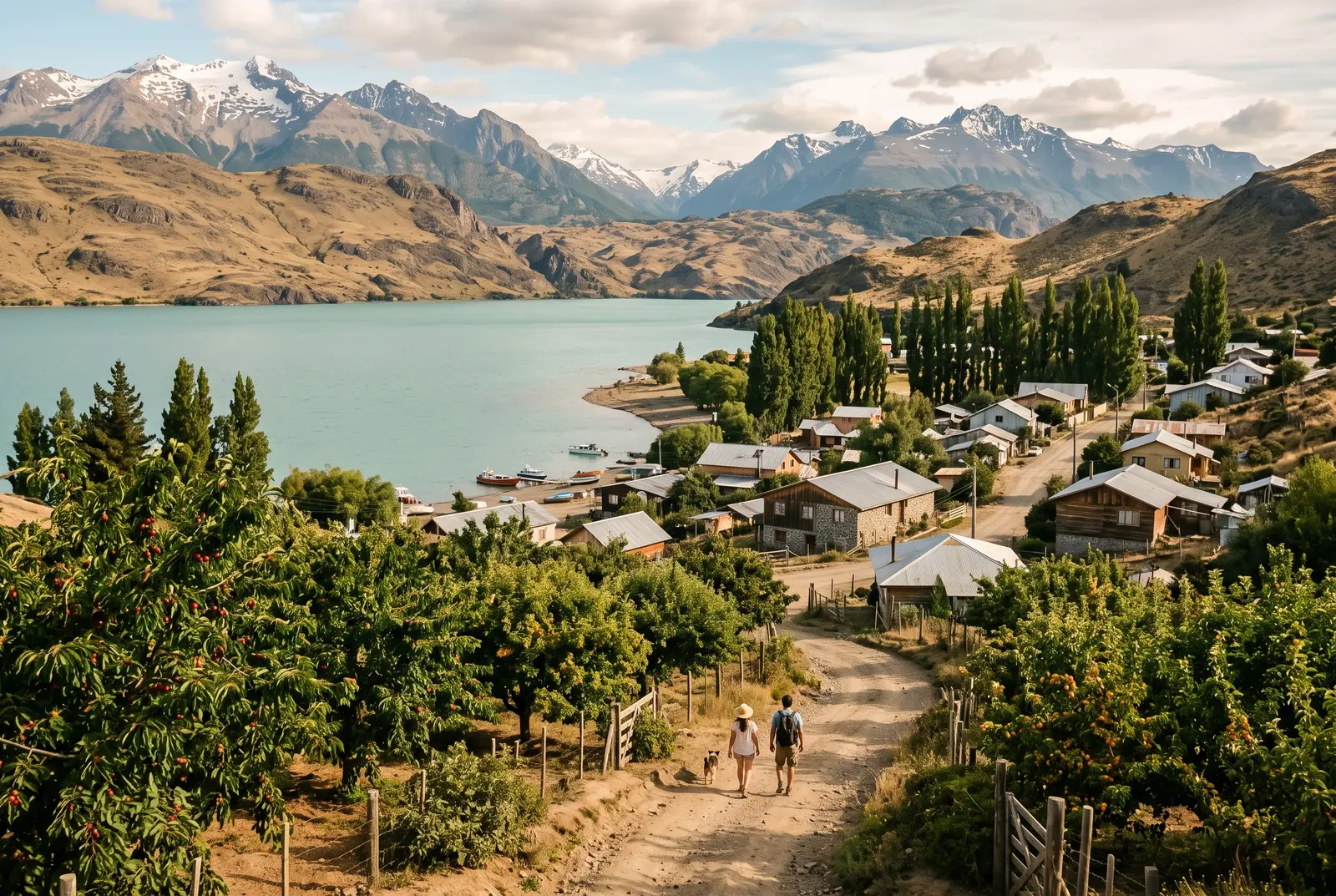 Chile Chico’s microclimate supports orchards in Patagonia. See property in Chile Chico.
How to actually decide
Forget the town names for a moment. Three questions decide this.
1. How old is your youngest child?
Under 6: any of the four works. Preschool and early primary are well covered everywhere, and small towns are arguably better at this age.
6 to 12: Coyhaique and Puerto Aysen give you choice and the ability to change schools. Chile Chico and Cochrane give you small classes and a single option. Both are defensible.
13 and up: the calculus shifts hard toward Coyhaique and Puerto Aysen. Secondary results in the small communes are weaker, subject choice is narrow, and the alternative is sending a teenager away from home. If your child is 13 and you are choosing between Cochrane and Coyhaique, you are effectively choosing between a beautiful five years and your kid’s university options.
2. What is your medical risk profile?
Be blunt with yourself. Chronic conditions, a planned pregnancy, an asthmatic child, an aging parent moving with you: each of these pulls the answer toward Coyhaique or Puerto Aysen. If everyone is healthy and you are comfortable with a four-hour drive for anything complex, the south opens up.
The asthma case is the exception that flips the logic: a respiratory-sensitive child argues for Puerto Aysen or Chile Chico over Coyhaique, despite Coyhaique’s hospital.
3. Can you tolerate winter here?
Not the cold, the darkness and the logistics. Short days, wet or frozen roads, and a social calendar that shrinks to the people within walking distance. Families who thrive here have an indoor life: instruments, workshops, books, projects. Families who struggle are the ones who planned around the outdoors and then met July.
The cheapest way to test this is to rent for one winter before buying. It costs you a year and saves some people a very expensive mistake. Our guide to the best time to buy property in Patagonia explains why a winter visit is also your strongest negotiating position.
Pro Tip: Visit schools in person before you commit, in June or July rather than January. Ask about the number of students per grade, teacher turnover, and what happens in the year your child would start secondary. Directors in small towns answer these questions honestly.
The practical checklist before you buy
Once you have a town, the house itself needs a family-specific inspection that a single buyer would skip.
Walking distance to school. In a place where winter mornings are dark and icy, a 10-minute walk versus a 25-minute drive changes daily life more than square metres do.
Insulation and heating. Ask about wall construction, glazing, and stove certification. In Coyhaique this is a health question. Everywhere else it is a cost question, since heating runs roughly half the year.
Internet. Confirm the actual connection type at the actual address, not the coverage map. Fibre is common in Coyhaique and Puerto Aysen, patchier elsewhere, and satellite is the fallback for rural properties.
Water and sanitation. Urban homes are on the network. Rural properties mean a well or a spring plus a septic system, and both need verifying before signing. Water rights are their own topic, and a serious one for anything rural.
Winter road access. If the property is off the paved network, ask who maintains the road, whether a school bus reaches it, and what happens after heavy snow.
The commute you will actually do. Not the scenic one. The Tuesday-in-August one, with two kids and a grocery run.
Where families actually end up
For most foreign families we work with, the pattern is predictable: they arrive in love with Puerto Rio Tranquilo or Cochrane, and they buy in Coyhaique or Puerto Aysen with a second property or a plan to build further south later. That is not a failure of nerve, it is the correct sequencing. Establish the family base where the services are, then buy the land you fell in love with once you know the region in winter.
If you want to see what that looks like in numbers, our Coyhaique cost of living guide breaks down what a household actually spends here. And when you have narrowed the shortlist, get in touch and we will tell you honestly which of these towns fits what you have described, including when the answer is none of them.
Frequently Asked Questions
Can foreign children enroll in Chilean public schools without residency?
Yes. Chile allows enrollment regardless of the migratory status of the child or the parents, and schools issue a provisional identifier for students without a Chilean RUN. In practice, small-town schools in Aysen are used to handling this and will walk you through it. You will need previous school records, ideally translated, and depending on the grade the school may apply a placement evaluation.
Do children in Aysen need to learn Spanish before arriving?
There is no English-medium school anywhere in the Aysen Region, so yes, your children will be educated in Spanish. Under about age 10 this is usually a non-issue and takes a few months. From roughly 12 upward it is much harder, because they are learning subject content and the language simultaneously. Families arriving with teenagers should plan for intensive Spanish before the move, not after.
What happens if there is a medical emergency in a small town at night?
Every commune hospital in Aysen has emergency coverage, and the regional network operates patient transfers by road and by air to the Hospital Regional de Coyhaique, and onward to Puerto Montt for anything beyond that. The realistic expectation in Chile Chico or Cochrane is stabilization locally and transfer within hours, weather permitting. Weather permitting is the operative phrase, and it is the main reason families with high medical risk choose the north of the region.
Is private health insurance worth it for a family in Aysen?
It depends on where you live. In Coyhaique there are private clinics and labs where an Isapre plan buys you speed and choice. In Chile Chico or Cochrane there is effectively no private provider to use it at, so the plan mostly buys you better conditions once you are transferred to Coyhaique or Puerto Montt. Many families in the far south run Fonasa plus a travel and evacuation budget instead.
Are there daycare and preschool options for working parents?
Yes in every commune covered here. Public preschool through JUNJI and Integra operates in the towns, and Coyhaique and Puerto Aysen also have private and subsidized options with longer hours. Availability in the smallest communes is limited by cohort size, so ask about actual places rather than existence of a centre. Rural families frequently rely on family networks rather than formal care.
Is it realistic to homeschool in the Aysen Region?
Chile does not have a broad homeschooling framework equivalent to the United States. The usual legal path for families educating at home is enrolling children as free candidates for validation examinations that certify each level. It is workable, and some remote families in the region do it, but it requires deliberate planning and periodic travel to an examination centre. If homeschooling is central to your plan, verify the current requirements with the Ministry of Education before you buy.
Which town should I choose if I only care about air quality?
Puerto Aysen, on the evidence. Its wet, windy climate prevents the winter inversion that traps wood smoke in the Coyhaique valley, and it now has a medium-complexity hospital so you are not trading air for healthcare access. Chile Chico is also a strong option on air, but the distance to specialist care is the trade-off you take in exchange.
Interested in buying land in Patagonia?
We connect buyers with the best opportunities in Chile's Aysen Region. Tell us what you're looking for and we'll help you find it.
No commitment. Your information is kept confidential.
Written by
Nicolas GorroñoFounder & Editor
Founder of Patagonia Properties. Grew up in Coyhaique, lived in Australia, and is now back in Patagonia full-time. SEO and digital marketing specialist.
LinkedIn