Remote Work from Patagonia: The 2026 Digital Nomad Guide to Aysen
TL;DR Yes, you can genuinely work remotely from Chilean Patagonia. Chile has no dedicated “digital nomad visa,” but its Temporary Residence permit is arguably better: it leads to permanent residency and citizenship. The Aysen Region is far better connected than its wilderness reputation suggests, with fiber reaching towns like Coyhaique and Starlink covering the truly remote spots. Aysen sits at UTC-3 year-round (great overlap with US East Coast, workable with Europe), and foreigners are taxed only on Chilean-source income for their first three years. Coyhaique is the practical base: real coworking spaces, an airport, and one of the cheaper regional capitals in Chile.
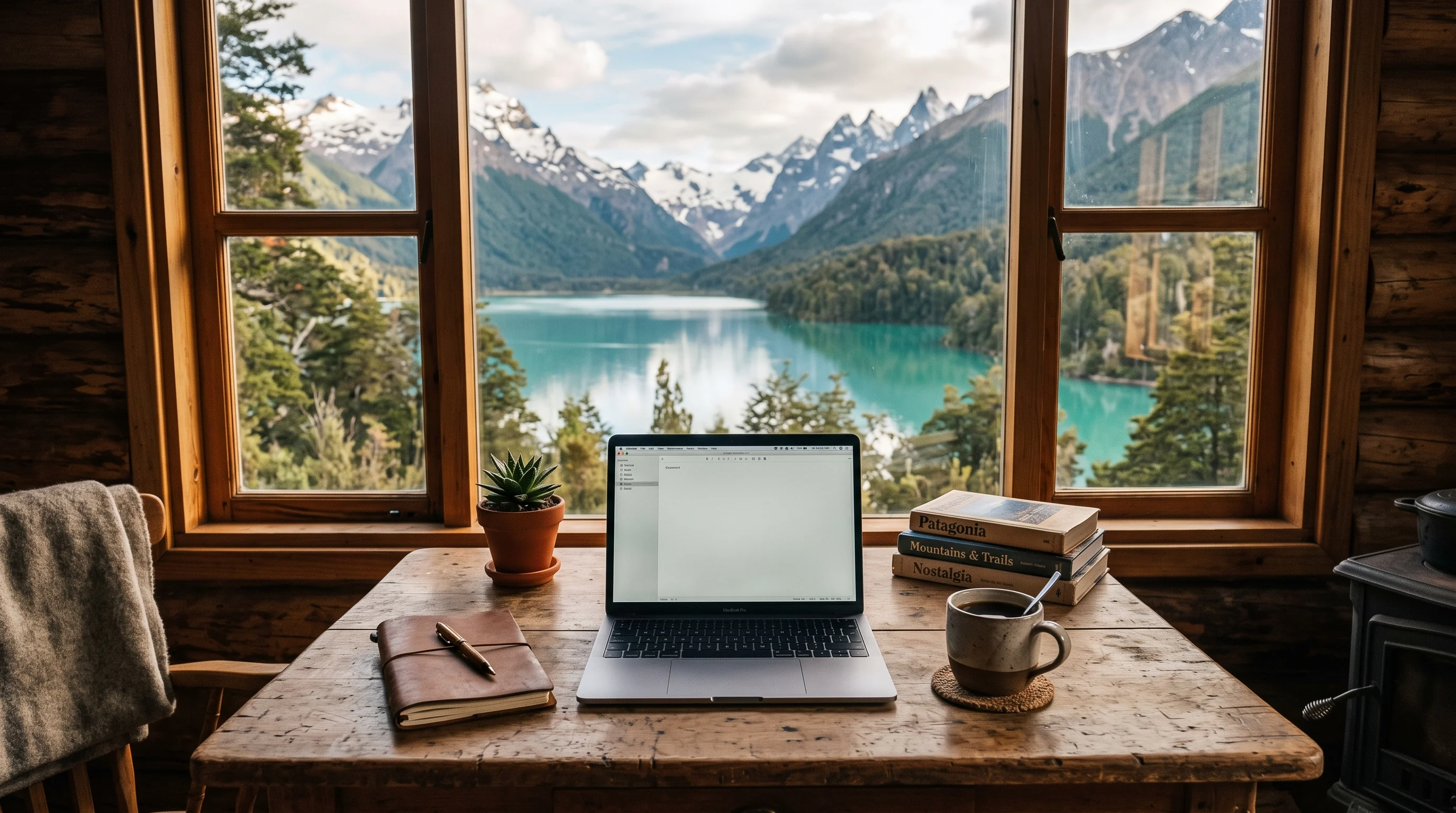 A home office with a view in Chilean Patagonia. Browse houses for sale in Coyhaique.
Can you actually work remotely from the end of the world?
Patagonia has a reputation problem when it comes to remote work. Say “Aysen Region” and most people picture a place so wild and disconnected that a video call would be a miracle. That picture is about a decade out of date.
The reality in 2026 is that Chile quietly built some of the fastest internet in the world, and it did not skip the south. Between a massive state-funded fiber project running down the Carretera Austral and near-universal Starlink coverage filling the gaps, you can now take a Zoom call from a cabin on a fjord that had 1990s-era connectivity just a few years ago.
At the same time, the fundamentals that made Patagonia attractive have not changed. Property is cheap by North American or European standards, nature is on a scale that does not exist in most of the world, and the pace of life is the exact opposite of a burned-out metro. For a growing number of remote workers, that combination is the whole point.
Key Insight: Aysen posted the highest fixed-internet upload speeds of any Chilean region in Subtel’s late-2025 measurements. Upload speed is exactly what matters for video calls, screen sharing, and pushing large files, the daily reality of remote work.
This guide walks through the real logistics: what visa you actually need, how good the internet actually is town by town, what it costs, how Chilean taxes treat your foreign income, and where to base yourself.
The visa question: there is no digital nomad visa (and that is fine)
Let’s clear up the single most common piece of misinformation first. You will find blog posts claiming Chile launched a “digital nomad visa” in early 2025. It did not. There is no visa category in Chile called “digital nomad” or “remote worker.”
What Chile does have is the Temporary Residence permit (Residencia Temporal), granted by the Servicio Nacional de Migraciones. This is what remote workers actually use, and in some ways it is a better deal than a dedicated nomad visa.
Why the residence permit beats a nomad visa
A typical digital nomad visa in other countries is a dead end: it lets you stay for a year or two and then you have to leave. Chile’s Temporary Residence permit is a genuine on-ramp. It is valid for up to two years and renewable, and after 24 months you can apply for permanent residency (Residencia Definitiva). Stay the course and citizenship becomes possible at around five years.
What you need and how to apply
The application is done entirely online through the official extranjeria.gob.cl portal. Migraciones is explicit about this: do not apply through any other channel. In general terms, you will need:
- A valid passport
- A clean criminal record certificate
- Proof of stable foreign income (practitioners typically cite around USD 1,000 to 1,500 per month, though Chile does not publish a rigid threshold for this)
- Health coverage
- Documents as PDFs under 2MB each, with certified Spanish translations for anything not in Spanish or English
Important: Processing is slow. Temporary residency applications are currently running roughly 6 to 8 months thanks to a backlog from Chile’s 2022 migration-law overhaul. Start early, and do not book a one-way flight expecting instant approval.
Can you just come as a tourist?
Citizens of the US, Canada, the UK, Australia, and EU states can enter Chile visa-free for 90 days as tourists (Permanencia Transitoria), extendable once. Here is the honest legal nuance: tourist status does not authorize paid work performed in Chile. Remote work for a foreign employer with income sourced abroad sits in a genuine grey area, and the clean, safe route is the Temporary Residence permit. If you are testing the waters for a few weeks, a tourist entry is fine. If you plan to actually live and work here, get the residence permit.
Internet in Aysen: better than you think
This is the part that surprises people. Chile’s national median fixed broadband download speed sits around 280 Mbps, which puts the country among the fastest in the world. Fiber now makes up the large majority of Chile’s fixed connections, and household broadband penetration has reached about two-thirds of homes.
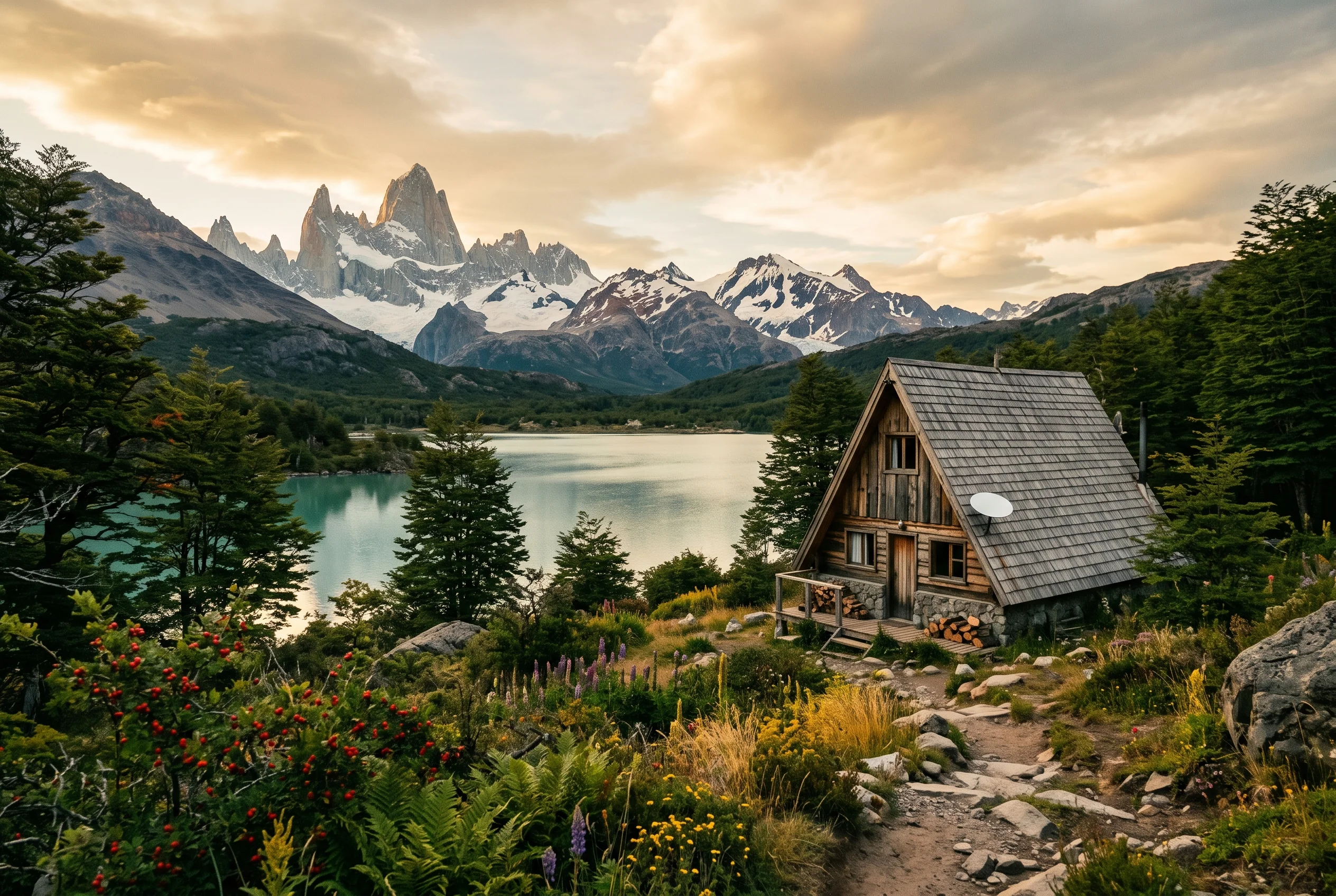 Even remote cabins now have connectivity. See land and parcels for sale in Aysen.
The Fibra Optica Austral project
The reason the deep south is connected at all is a roughly USD 100 million state project called Fibra Optica Austral (FOA). It lays nearly 3,000 km of fiber (mostly submarine cable) linking Los Lagos, Aysen, and Magallanes to the rest of Chile. The submarine trunk even reaches Caleta Tortel, one of the most isolated coastal communities in Aysen. It is an open-access network, meaning any provider can use it, which keeps prices honest.
Starlink fills the gaps
Where fiber does not reach (and in rural Patagonia, that is a lot of places), Starlink has been transformative. Chile had roughly 156,600 Starlink subscribers by early 2026, and Aysen is prime territory for it. The standard residential plan runs about CLP 47,000 per month with a hardware kit around CLP 337,000. Residents in remote Patagonia report jumping from 1 to 2 Mbps on old satellite systems to 50 to 100 Mbps on Starlink, which is the difference between “can’t work here” and “office with a view.”
Pro Tip: If you are buying or renting a remote property, budget for Starlink as your primary connection and treat any local fiber as a bonus. The one-time kit cost pays for itself the first time you close a client call from a place with no cell signal.
Town by town, realistically
Coyhaique, the regional capital, is your safest bet for reliable fiber, redundancy, and services. It is where you base yourself if uptime is non-negotiable. Puerto Aysen and Chile Chico are also well served. As you go further out, to Villa O’Higgins at the end of the Carretera Austral or Caleta Tortel on the coast, connectivity thins out and Starlink becomes essential rather than optional. There is no official town-by-town speed dataset for the tiniest villages, so the rule of thumb is simple: the smaller and more remote the town, the more you should plan to bring your own connection.
Coworking and where to actually get work done
You do not have to work from your kitchen table. Coyhaique has a small but real coworking scene, unusual for a town of around 50,000 people at 45 degrees south.
Options that have operated in the region include Baquedano 400 (B400), a Corfo-backed nonprofit coworking space in Coyhaique, Casa Sinergia Aysen, also in Coyhaique, and Ecoterraneo Patagonia Cowork in nearby Puerto Aysen. As with any small-market coworking, spaces come and go, so confirm current hours before you show up. Beyond dedicated coworking, Coyhaique has a growing cafe culture and, being the administrative hub of the region, decent business infrastructure.
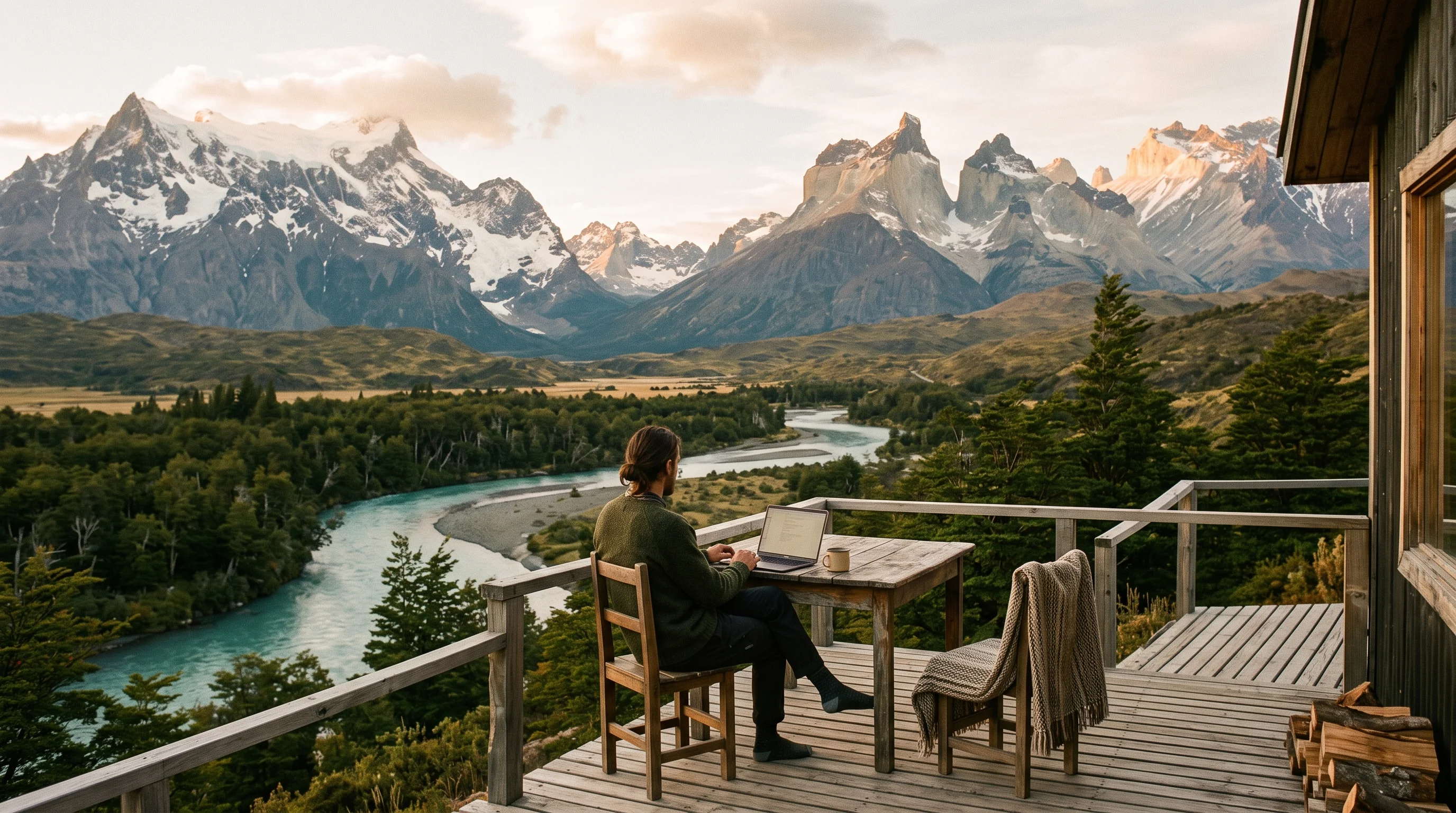 The Patagonia home-office dream. Explore cabins for sale in the Aysen Region.
Time zones: Patagonia’s secret weapon for remote work
Here is an underrated advantage. As of a 2025 decree, Aysen observes UTC-3 permanently, all year round, with no clock changes. The region adopted this after a citizen consultation in which 94.4% voted in favor of ditching the seasonal switch.
Why does this matter for remote work? At UTC-3, Aysen is only 1 to 2 hours ahead of US Eastern Time depending on US daylight saving. If your team or clients are on the US East Coast, you have almost a full overlapping workday. For European teams, you are roughly 4 to 5 hours behind Central Europe, which gives you a solid morning overlap. Very few genuinely remote, nature-first destinations line up this cleanly with the two biggest remote-work markets.
Did You Know: No twice-a-year clock changes means no scheduling chaos with international clients. While the rest of Chile shifts between UTC-4 and UTC-3, Aysen stays put, so your calendar overlap with New York or London is predictable every single week.
Taxes: the three-year head start
This is where remote workers earning foreign income get a pleasant surprise. Chilean tax residency triggers when you spend more than 183 days in Chile within any 12-month period. So far, standard.
The good part: under Chile’s Income Tax Law (DL 824, Article 3), foreigners who establish residence are taxed only on Chilean-source income for their first three years. Your salary or client income from abroad is not taxed in Chile during that window. Only after three years does worldwide income come into scope (and even then, subject to any applicable double-taxation treaty).
For a remote worker whose entire paycheck comes from outside Chile, that is a meaningful three-year runway. It is one of the more generous setups for new arrivals anywhere in the region.
Numbers That Matter: 183 days makes you a Chilean tax resident. 3 years is how long your foreign-source income stays exempt. Plan your stay and your finances around both of those numbers, and talk to a Chilean contador before year three.
None of this is a substitute for professional advice. Tax residency, the foreign-income exemption, and any treaty interactions get complicated fast if you have investment income, own a business, or split time between countries. A Chilean accountant is a small, worthwhile expense.
What it costs to live and work in Aysen
Patagonia is remote, so a few imported goods cost more, but the overall picture is friendlier than people expect. According to INE household expenditure data for 2023 to 2024, the average urban Aysen household spent about CLP 1,074,350 per month, with housing and utilities taking roughly 30% and food about 16%.
Rent
In Coyhaique, one and two bedroom apartments start from roughly CLP 350,000 per month, with furnished central units around CLP 500,000 and larger, well-located apartments running higher. If you would rather own, we break down the local market in our Coyhaique apartment price analysis and our full cost of living in Coyhaique 2026 guide.
The catch: goods and heating
Coyhaique consistently ranks as one of the cheaper regional capitals in Chile overall, but transport from central Chile pushes food roughly 10 to 20% above Santiago prices and clothing can run nearly double. Winters are cold, so budget for heating (a common estimate is around CLP 80,000 per month on average, more in deep winter). Factor Starlink, heating, and the occasional pricey grocery run into your numbers and you will not be surprised.
Should you rent first or buy?
If you are testing the digital nomad life in Patagonia, rent for a season before committing. Aysen is not for everyone: winters are dark and long, some goods are hard to get, and the isolation that reads as “peaceful” in July can feel like a lot in a stormy August.
But if the lifestyle clicks (and for a certain kind of person it clicks hard), buying is remarkably attainable. A cabin on acreage here costs a fraction of a city apartment back home, and the region is still genuinely early-stage compared to more “discovered” nomad hubs. Start with our guide to buying property as a foreigner in Chile, browse current listings across the Aysen Region, or contact our team to talk through what a remote-work base in Patagonia would actually look like for you.
Frequently Asked Questions
Is the internet in Patagonia reliable enough for daily video calls?
In and around Coyhaique, yes: fiber connections there are comparable to major Chilean cities, and Chile’s national median fixed download speed is around 280 Mbps. In truly remote areas, reliability depends on Starlink, which typically delivers 50 to 100 Mbps and handles video calls well. The practical advice is to base yourself in or near Coyhaique if uptime is critical, and to install Starlink as your primary connection anywhere rural.
Do I need to speak Spanish to work remotely from Aysen?
For your job, no, since your work is remote and presumably in your own language. For daily life, it helps enormously. Aysen is deeply local and English is far less common than in Santiago or tourist hotspots. You can get by at first with translation apps and patience, but investing in Spanish will transform your experience, especially when dealing with the migration portal, banks, or a landlord.
Can I open a Chilean bank account as a remote worker?
It is much easier once you hold a Temporary Residence permit and a RUT (Chilean tax ID). On a tourist entry alone, opening a traditional bank account is difficult. Many new arrivals bridge the gap with international fintech accounts and cards until their residency and RUT come through, then open a local account.
What is the internet like specifically in the smallest villages like Villa O’Higgins or Caleta Tortel?
Thinner than in Coyhaique, and there is no official published speed data for these tiny communities. Fiber has reached parts of the deep south through the Fibra Optica Austral project, but coverage is patchy at the village level. For any of the smallest, most remote towns, plan on Starlink as your main connection rather than assuming local fixed broadband will carry your workday.
How cold does it get, and can I really work through a Patagonian winter?
Aysen winters are cold, wet, and dark, with short days from roughly June to August. It is entirely workable if your home is well heated and insulated (budget for it), but it is a real adjustment for people coming from mild climates. Many remote workers who love Patagonia treat winter as heads-down work season and summer as the reward. Renting through one winter before buying is smart.
Will working remotely from Chile affect my taxes back home?
Possibly, and it depends entirely on your home country’s rules. The US, for example, taxes citizens on worldwide income regardless of where they live, while many other countries stop taxing you once you become non-resident. Chile’s three-year exemption on foreign-source income addresses the Chilean side, not your home country’s. Coordinate with a tax professional in your home country before making the move permanent.
Is there a community of other remote workers and expats in the region?
It is small but real and growing, concentrated in Coyhaique. You will find it through coworking spaces, outdoor and adventure groups, and the general expat network. It is nothing like the dense nomad scenes of Medellin or Lisbon, which is exactly the appeal for people who want nature and quiet over a party circuit. If community density is your top priority, Aysen may feel isolated; if it is not, that same quiet is the whole draw.
Interested in buying land in Patagonia?
We connect buyers with the best opportunities in Chile's Aysen Region. Tell us what you're looking for and we'll help you find it.
No commitment. Your information is kept confidential.

Written by
Nicolas GorroñoFounder & Editor
Founder of Patagonia Properties. Grew up in Coyhaique, lived in Australia, and is now back in Patagonia full-time. SEO and digital marketing specialist.
LinkedIn