Retiring in Chilean Patagonia: The 2026 Guide for Americans
TL;DR Chile has a retirement visa (the jubilado subcategory of temporary residence) and you apply from outside Chile through the SERMIG portal with an apostilled pension certificate. There is no published minimum income: an official decides whether your pension covers basic needs. Medicare does not follow you across the border, so you will join Fonasa or an Isapre. Your Social Security check does follow you, thanks to a totalization agreement in force since 2001. And for your first three years as a Chilean tax resident you are taxed only on Chilean-source income, which is the single most underrated fact in this entire article. The catch is not paperwork. It is that Aysen has 100,745 people spread over an area the size of Kentucky, and the nearest cardiologist may be a flight away.
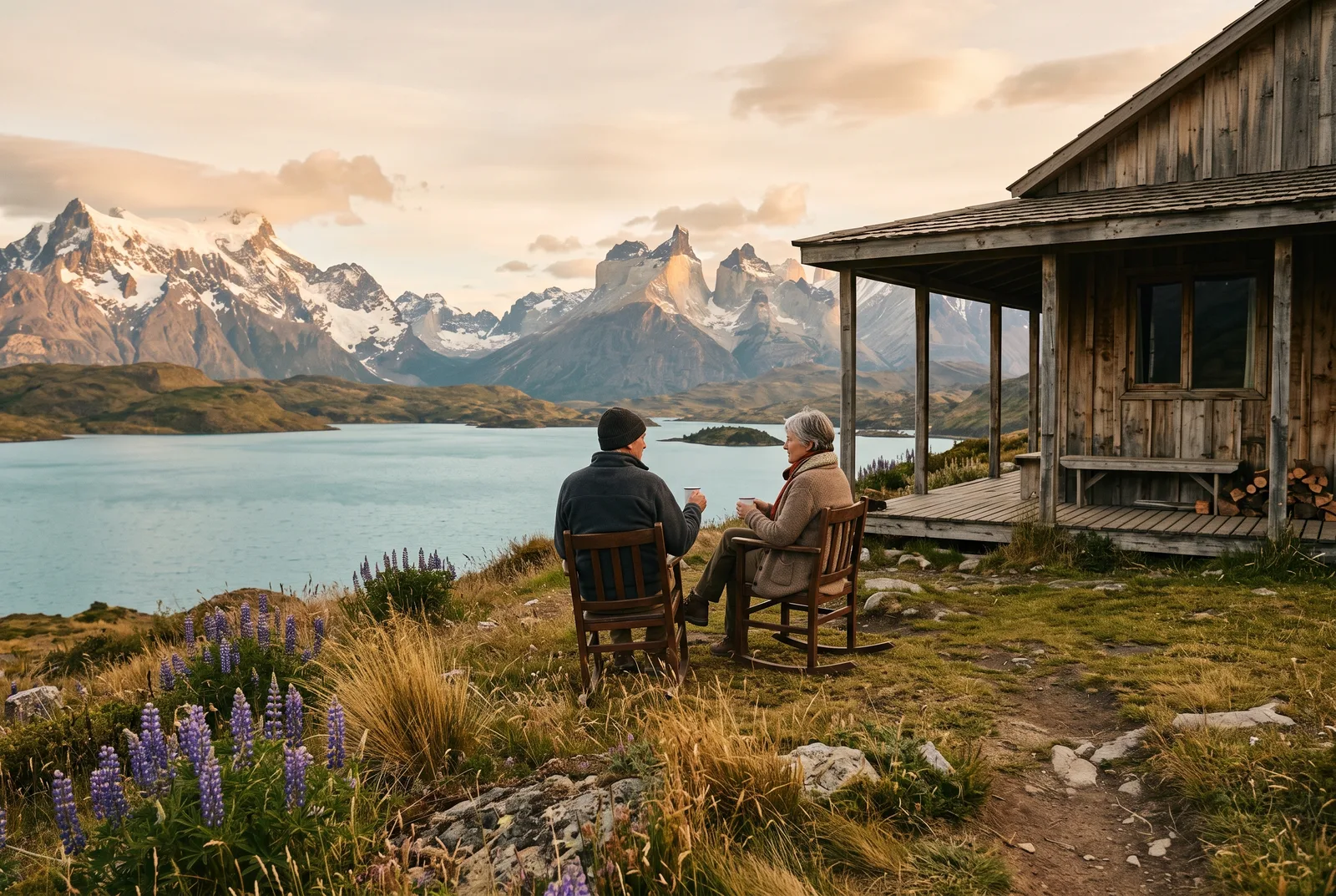
The version of this that people picture. Browse cabins and houses for sale in the Aysen Region.
Everyone retires to Costa Rica. You are reading about Patagonia.
There is a well-worn groove for American retirement abroad. Costa Rica, Panama, Portugal, Mexico. Warm, cheap, plenty of English, an established expat scene with a Facebook group and a guy named Dave who knows a lawyer.
Aysen is not that. Aysen is the Chilean region that starts roughly where the road stops being a highway and starts being an argument. It has 100,745 inhabitants at a density of about 0.93 people per square kilometer, which makes it the least populated region in Chile and one of the emptiest inhabited places in the Americas. Winter is dark and long. Fresh produce arrives by truck from a thousand kilometers north. The English-speaking community is small enough that you will meet most of it within a month.
And people still move here, on purpose, in their sixties. Usually for a very specific reason: they wanted the thing Patagonia actually has, which is space, rivers, silence and a functioning first-world state, at a price that has not yet been discovered by the people who discovered Bariloche.
This guide is the practical version. Visa, healthcare, taxes, money, and the honest downsides. If you want the buying mechanics rather than the living mechanics, we covered those separately in buying property in Chile as an American.
Numbers That Matter: Aysen lost population between the 2017 and 2024 censuses, the only Chilean region to do so. That is not a market warning. It is why a river-front hectare here still costs what a parking space costs in Santiago.
The visa: which one you actually want
Chilean immigration runs on Ley 21.325, the Migration and Foreigners Law published in April 2021, administered by SERMIG (Servicio Nacional de Migraciones). What you want is a Residencia Temporal in the subcategory for retirees and rentiers.
There are two flavors under the same door.
Jubilado is for people drawing a retirement pension from a public or private pension system in their home country. Social Security counts. A federal or state pension counts. A private annuity from a pension scheme counts.
Rentista is for people living off passive income rather than a pension: rental income from property, or income from financial assets. This matters more than it sounds, because plenty of early retirees are 58 and living off a portfolio, not a pension. If that is you, you are a rentista, not a jubilado, and the document list is different.
What SERMIG actually asks for
For the jubilado route, the official requirement list is short and specific:
- A passport valid for at least one year from the application date
- A criminal record certificate, valid for a maximum of 60 days from issuance, required for everyone over 18
- A recent color photo, white background, neutral expression, no accessories
- A retirement certificate stating your income and the pension period, legalized or apostilled
- The receipt for your last pension payment, legalized or apostilled
For the rentista route, swap the last two for an ownership certificate for the asset, the lease contract or equivalent, and documents proving the income it produces. Note one nice detail: the ownership certificate does not need to be apostilled if the property or financial asset is Chilean. Buy the Chilean property first and one piece of your paperwork gets simpler.
“Apostilled” is the word that trips people. It means a specific authentication stamp under the Hague Convention, issued in the US by your state’s Secretary of State for state-issued documents and by the US Department of State for federal ones. A Social Security award letter is a federal document. Budget several weeks and do not leave it until the month you want to fly.
The number nobody will give you
Here is the part that frustrates Americans used to a published threshold. SERMIG does not publish a minimum income. The stated test is that your income must “allow them to satisfy at least their basic needs during their residence in the country, according to the parameters estimated by the Ministry of Social Development and Family.”
So an analyst reads your pension figure and decides. The underlying yardstick is public: the Ministry publishes monthly basic food basket and poverty line values, and those are the “basic needs” the rule points at. What it does not do is convert that into a visa threshold.
In practice, immigration advisers working these files in 2026 talk about roughly USD 1,000 to 1,500 per month for a single applicant plus USD 500 to 600 per dependent, with a lump sum sometimes accepted in place of a monthly flow. That is practitioner observation, not law, and you should treat it as a floor to clear comfortably rather than a line to sit on. A median US Social Security benefit is well above it.
Important: You apply from outside Chile. The SERMIG portal is explicit about it: temporary residence in this subcategory is filed abroad through the Portal de Tramites Digitales using ClaveUnica or an applicant account. The old trick of flying in as a tourist and converting on the ground is not this route.
Temporary, then permanent, then a passport if you want one
Temporary residence is not the destination. It is the runway.
To move up to Residencia Definitiva, applicants who filed after May 14, 2022 need a minimum of 24 months of residence in Chile, no Chilean criminal record, and proof of means of subsistence. The application goes in before your temporary permit’s extension deadline, no more than 90 days ahead of expiry. Miss that window and you restart a process you have already paid for once.
Naturalization is a separate, later question. Chile requires you to be 18, to hold a valid Residencia Definitiva, and to have five or more years of residence counted from your first electronic stamp. Most American retirees never bother. Permanent residence gives you the healthcare, the banking, the property rights and the ability to leave and return. Citizenship mostly gives you a vote and a second passport, and comes with its own tax questions worth asking an accountant about first.
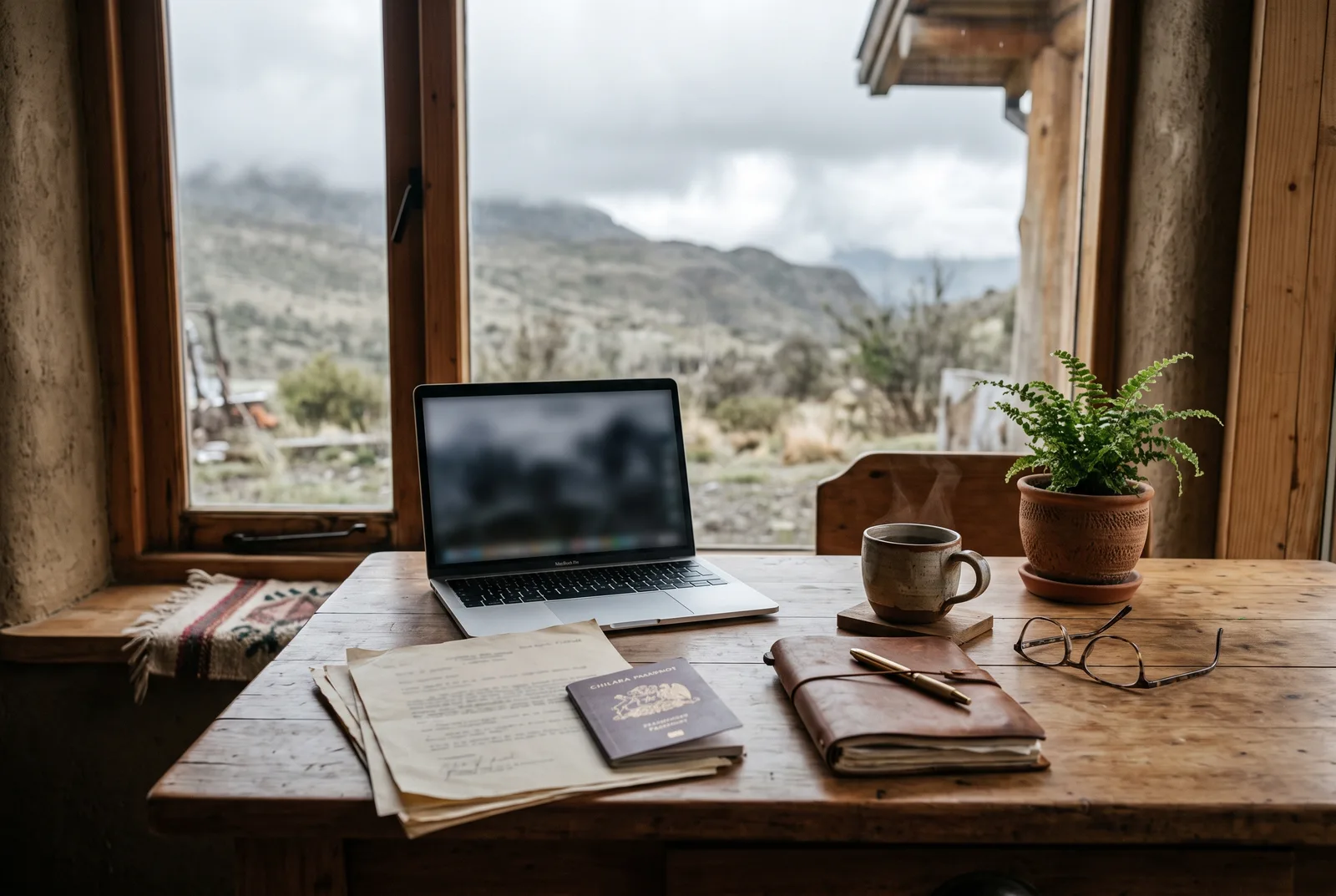 Most of the first year happens at this desk, not on the porch. If you want a hand with the property side, get in touch.
Healthcare: Medicare stops at the border
This is the section that changes people’s plans, so read it before you fall in love with a lake.
Original Medicare does not cover you in Chile. Medicare’s own guidance is blunt: outside the United States and its territories, it will not pay for your hospital care, your doctor visits, or your prescription drugs, with only narrow exceptions. Part D covers drugs bought in the US and its territories only. Medigap plans C through N typically add foreign emergency care at 80% of eligible charges with a USD 50,000 lifetime cap, which is a nice cushion for a broken ankle on a trip and not a healthcare plan for a decade of life abroad.
Many retirees keep paying the Part B premium anyway, as insurance against moving back. That is a personal call. What is not optional is joining the Chilean system.
Fonasa, the public option
Fonasa is Chile’s public health insurance fund. Foreigners can affiliate; what you need depends on your income and your migration status. If you are contributing to the Chilean system as a worker, affiliation looks much like a Chilean’s. If you are a resident retiree living on foreign income, the practical route is affiliating as an independent contributor, paying 7% of declared taxable income up to the legal ceiling.
Fonasa sorts members into tramos A through D by income, which sets your copay in the public network and your access to the Modalidad Libre Eleccion, the voucher system that lets you use private providers at a regulated tariff.
For older adults, Fonasa has one enormous structural advantage: it does not ask for a health declaration and cannot exclude you for age or a pre-existing condition. If you arrive at 66 with a stent and managed diabetes, this is the system that has to take you.
Isapres, the private option
Isapres are private health insurers. They generally offer faster access and a private provider network, which in a region like Aysen mostly means better access when you travel to Puerto Montt or Santiago.
The trade-offs are real. An Isapre cannot reject you for age, but prices plans using age and sex factors, which makes them expensive precisely when you need them. And you must complete a health declaration: the insurer can accept you outright, exclude a declared pre-existing condition temporarily (up to 18 months), or price you higher. Under-declare and you hand them grounds to unwind the contract later.
The common pattern among retirees in Aysen is Fonasa as the floor, plus a private supplementary or international policy for evacuation and elective care. Do not build a plan around an Isapre accepting you at 70 with a chart.
What the region actually has
Honesty section. The Hospital Regional de Coyhaique is the region’s high-complexity referral center and it handles far more than a town of 58,000 usually would. Smaller hospitals in Puerto Aysen, Chile Chico and Cochrane cover primary and secondary care, with visiting specialists on rotation.
What Aysen does not have is depth in every specialty. Complex oncology, advanced cardiac intervention and neurosurgery generally mean derivation north, by air, to Puerto Montt or Santiago. That system works and is used constantly. But if you have a condition that requires a named specialist every six weeks, choose Coyhaique over a lakeside plot four hours down a gravel road, and price a flight or two per quarter into your budget. Our town-by-town comparison of schools and healthcare breaks this down by comuna.
Local Tip: The relevant question in Aysen is not “is there a hospital” but “how far am I from the airport at Balmaceda.” That single distance quietly determines how good your healthcare is when it matters.
Taxes: the three-year window
Now the good part.
Chile taxes worldwide income, eventually
You become a Chilean tax resident when you are physically present in Chile for more than 183 days, consecutive or not, within any twelve-month period.
But here is the provision that should shape your first three years: for the first three years of stay in Chile, counted from arrival, a foreigner pays Chilean tax only on Chilean-source income. After that term, worldwide income comes into scope. Your US pension, your IRA distributions, your rental income in Ohio: outside the Chilean net for that opening window, then inside it.
Three years is enough time to do serious planning. Roth conversions, realizing gains, restructuring accounts, deciding whether you actually want to be a long-term Chilean tax resident. Retirees who learn about this rule in year four are usually annoyed for good reason.
The American side does not go away
You are a US citizen. You file. Living in Aysen changes nothing about that, and the Foreign Earned Income Exclusion is irrelevant to you because a pension is not earned income.
What does help is the US-Chile income tax treaty, which entered into force on December 19, 2023 and took effect for withholding taxes from February 1, 2024 and other taxes from January 1, 2024. It is the first comprehensive bilateral tax treaty between the two countries, it caps Chilean withholding on dividends, interest and royalties, and it contains provisions governing pensions and social security payments. If you hold Chilean investments, or expect to, this treaty is the reason your accountant should be a US international specialist rather than the person who has done your 1040 since 1998.
Also on the list: FBAR and FATCA reporting on Chilean bank accounts, which are easy to file and expensive to forget, and Chilean property tax (contribuciones), which we covered in the annual property tax guide.
Your Social Security check follows you
The United States and Chile signed a Social Security agreement in Santiago on February 16, 2000, and it entered into force on December 1, 2001: the first US totalization agreement with a South American country, and one of the roughly 30 in force today.
Practically, it does three things. It stops you paying into both social security systems for the same work. It lets you combine (totalize) credits from both countries to qualify for a benefit you would otherwise fall short of. And it covers old-age, disability and survivors benefits, plus Chilean national health insurance and workers’ compensation contributions. Self-employed US citizens living in Chile are not required to pay US Social Security contributions on that self-employment income.
Chile is also not on the short list of countries where SSA cannot send payments. Your benefit can be deposited into a Chilean bank account, though most retirees keep a US account and move money as needed.
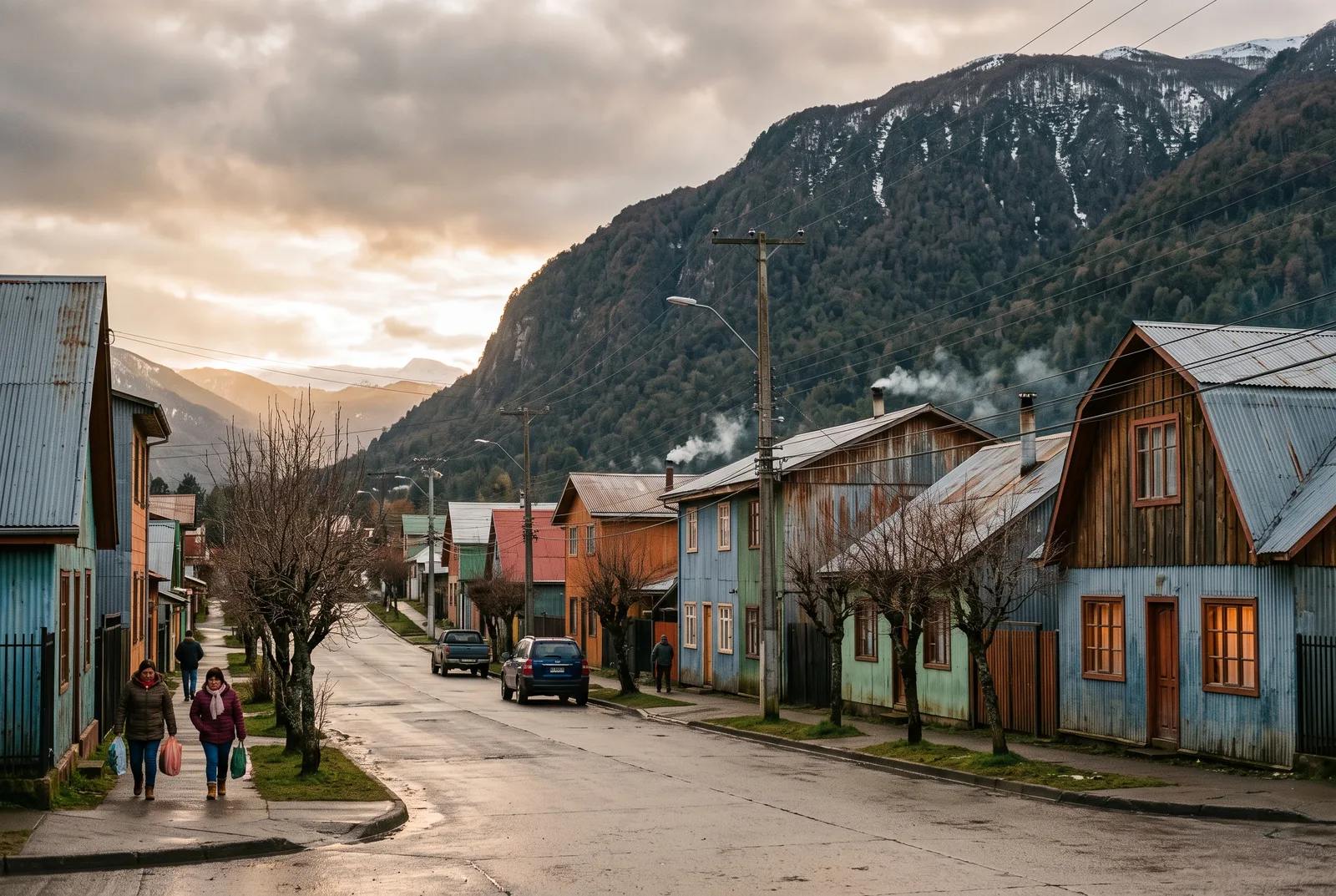 Nine months of the year, this is the postcard. See houses for sale in Coyhaique.
What it actually costs
Two budgets matter: the one-time purchase and the monthly burn.
On the monthly side, Coyhaique is meaningfully cheaper than Santiago on housing and meaningfully more expensive on anything that arrives by truck. Rent runs roughly CLP 300,000 to 420,000 for a one-bedroom apartment and CLP 400,000 to 650,000 for a two or three-bedroom house. Heating is the line item that surprises northern-hemisphere retirees, because it runs eight or nine months and can dominate a winter budget. Our full cost-of-living breakdown for 2026 has the category-by-category numbers.
A realistic all-in figure for a couple living comfortably in Coyhaique, renting, eating well, running one car and flying north twice a year, sits well under what the same life costs in most US retirement destinations. A couple living on a river outside town, heating with firewood and growing part of their food, spends dramatically less and drives dramatically more.
On the purchase side, the region still prices like a place nobody has found. A one to two bedroom apartment in Coyhaique lands in the UF 1,800 to 2,800 range, and rural land with water and a view remains the category where the gap against Argentine Patagonia is widest. Timing matters too: winter is a buyer’s market and summer is when the property looks its best, which is exactly the tension we unpacked in the seasonal buying guide.
Rent first. Genuinely.
The single most common regret among people who move to Aysen is buying in February.
February is glorious. Long light, warm afternoons, the lake the color of a mouthwash advertisement. It is also a lie about ten months of the year. Rent through one full winter before you buy. If June and July do not break you, buy in August when the sellers are motivated and the property is showing its worst face. You will be negotiating from a position no summer visitor ever occupies.
The parts nobody puts in the brochure
Distance is the tax you actually pay. Aysen’s road network is a single spine with branches. A trip that looks like 200 kilometers on a map can be six hours and a ferry. Weather closes passes. Flights out of Balmaceda cancel for wind. If your retirement plan involves frequent, reliable, same-week travel, this is a friction you will feel every month.
Winter smoke is a real health issue. Coyhaique’s valley traps woodsmoke, and air quality on still winter days is genuinely poor. It is the reason regional policy pushes certified dry firewood, pellets and electric heating. If you have respiratory issues, ask about the specific neighborhood, not just the town.
Spanish is not optional. Not in Aysen. The tourist-facing English of Santiago or Pucon thins out fast here, and it disappears entirely at the hospital reception desk, the municipality and the notary. Arrive with functional Spanish or arrive with a plan to get there in the first year.
Bureaucracy is orderly, slow and utterly literal. Chile is not a corrupt place to do paperwork. It is a formal one. Documents must be exactly right, notarized where required, apostilled where required. There is no charming workaround. There is only the correct document, obtained the second time.
The community is small, which cuts both ways. You will be known within weeks. Help arrives without being asked when your pipes freeze. Privacy, on the other hand, is a concept you will be renegotiating.
Pro Tip: Do the visa, the RUT (Chilean tax ID) and a local bank account before you buy anything. Buying property as a non-resident is legal and common, but every subsequent step, from utilities to healthcare to a mortgage, is easier once you exist in the Chilean system.
Is it for you?
There is a filter question, and it is not about money.
Ask yourself whether you are moving toward something or away from something. Retirees who move to Aysen because they want rivers, weather, space and a slower life tend to stay. Retirees who move to escape a cost problem, a healthcare problem or a political mood tend to discover that Aysen has weather, distance and a supermarket with four kinds of cheese, and that none of those solve what they were running from.
If you are in the first group, this is one of the last genuinely beautiful, genuinely functional, genuinely affordable places left. Come in June. If you still want it in June, you want it.
Frequently Asked Questions
Can I buy property in Chile before I have a visa?
Yes. Chile allows foreigners to buy property without residence, and a passport plus a RUT (Chilean tax ID) is generally enough to complete a purchase. The exception is the border zone, where land near international frontiers has restrictions for foreign nationals of neighboring countries and requires additional authorization. Owning property does not by itself grant you residence, though it can support a rentista application if it produces income.
Do I need to give up my US citizenship or my Medicare?
No on both counts. Chilean permanent residence does not require renouncing US citizenship, and Chile permits dual nationality if you eventually naturalize. Medicare is a separate decision: many retirees keep paying the Part B premium so that coverage is intact if they return to the United States, even though it will not pay for care in Chile.
How long can I be outside Chile without losing my residence?
Residencia Definitiva can lapse if you are absent from Chile for an extended continuous period, so long snowbird arrangements need checking against your specific permit conditions. If you plan to spend half the year in the United States, confirm the absence rules with SERMIG before you commit, because the rules differ between temporary and permanent residence.
Can my adult children or grandchildren join me on my visa?
Dependents can be included in a family application, but the practical constraint is that SERMIG assesses whether your income covers each additional person’s basic needs. Adult children generally need their own basis for residence, whether work, study or their own income, rather than riding on a retiree’s pension.
What happens to my Chilean property when I die?
Chilean inheritance rules apply to Chilean real estate regardless of your nationality, and Chile has forced heirship provisions that can override a US will. This is one of the genuinely important reasons to get local legal advice early rather than assuming your existing estate plan travels with you.
Is it better to move to Puerto Varas or Puerto Montt first?
For many retirees, yes. The Los Lagos region has more medical depth, better flight connections and a larger foreign community, and a lot of people spend a year there while shopping for property further south. The trade-off is that prices and density are both higher, and the specific quality that draws people to Aysen is exactly the thing Puerto Varas has already lost.
Do I need a car, or can I manage without one?
In Coyhaique proper you can live without a car. Anywhere else in Aysen you cannot, and the vehicle you want is a high-clearance pickup or SUV rather than a sedan. Factor in that vehicles are relatively expensive in Chile and that gravel roads are hard on suspensions and windshields.
Interested in buying land in Patagonia?
We connect buyers with the best opportunities in Chile's Aysen Region. Tell us what you're looking for and we'll help you find it.
No commitment. Your information is kept confidential.
Written by
Nicolas GorroñoFounder & Editor
Founder of Patagonia Properties. Grew up in Coyhaique, lived in Australia, and is now back in Patagonia full-time. SEO and digital marketing specialist.
LinkedIn