Water Rights and Property in Chile: The 2026 Buyer's Guide
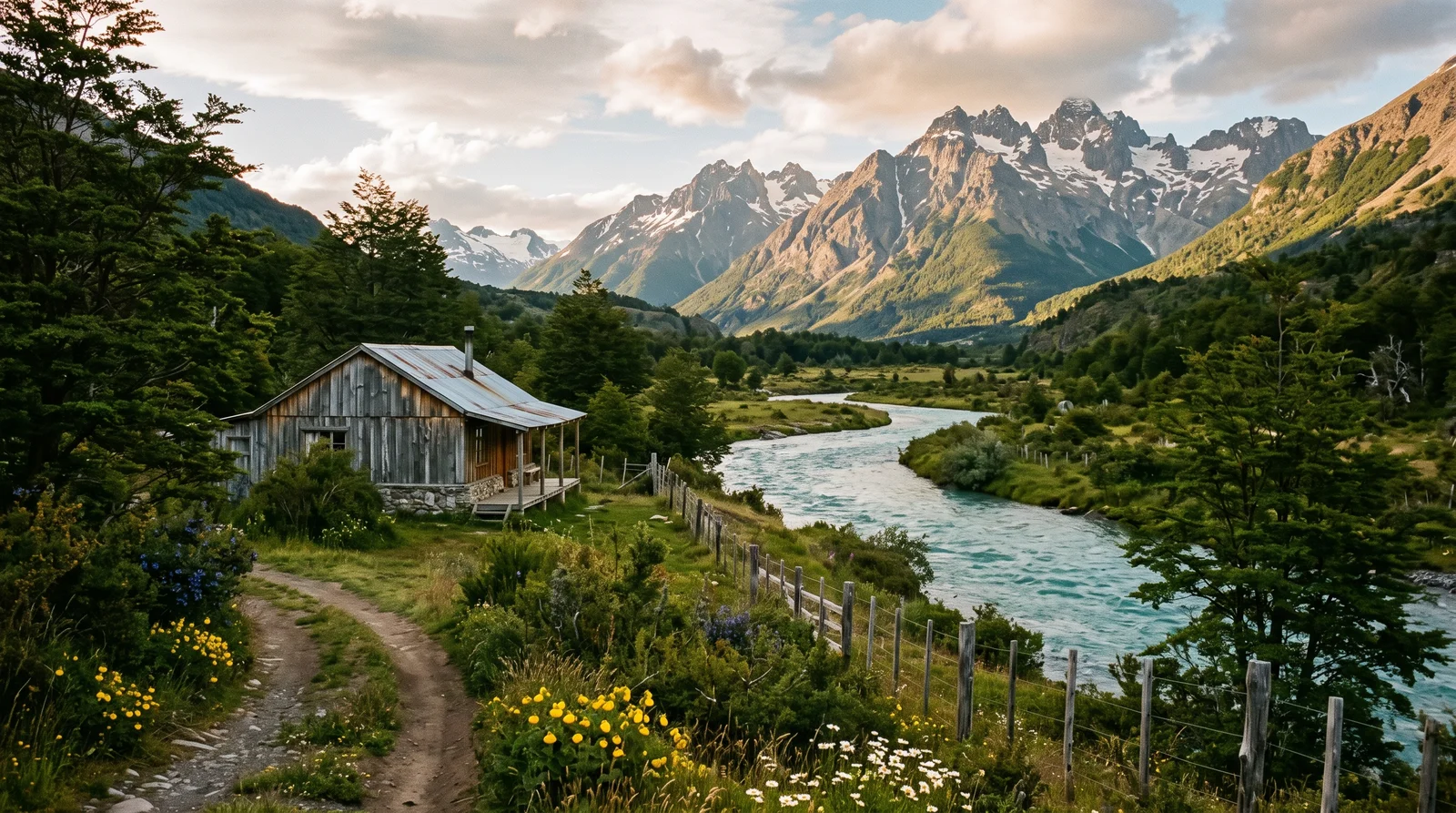
TL;DR In Chile, the land and the water are two separate purchases. A river running through your parcel does not mean you own a drop of it. The 2022 Water Code reform (Ley 21.435) made new rights temporary (30 years, auto-renewing), prioritized human consumption, and put every unused right on a clock. There is also a hard deadline: unregistered rights must be inscribed by April 6, 2027 or they lapse. And in a plot twist nobody outside the region expects, Aysen owes more in non-use water patents than any other region in Chile: about 128.5 billion pesos in 2026 alone.
A river on the boundary is not the same as a right to use it. Browse land for sale in the Aysen Region.
The most expensive assumption in Chilean rural real estate
Here is the scene. You are standing on eight hectares outside Coyhaique. There is a stream cutting diagonally across the paddock, clear enough to see the pebbles. The seller waves at it and says, in the tone of someone stating the obvious, “and of course you have water.”
You will nod. Everybody nods. And then, somewhere between the promesa and the first summer you actually try to irrigate something, you discover that “of course you have water” was doing an enormous amount of unpaid work in that sentence.
In Chile, water is a national good for public use. What private parties hold is not the water itself but a derecho de aprovechamiento de aguas: a right to use a specified flow, from a specified source, at a specified point. That right is a separate legal asset from the land. It has its own registration, its own title history, its own market price, and its own ways of quietly dying.
This guide is about buying. If you are on the other side of the table and need to hand your rights to a buyer, we wrote that up separately in water rights when selling land in Chile.
Key Insight: Land and water are two purchases with one price tag. If the escritura does not name the water right, you did not buy the water right. There is no “obviously it comes with the farm” doctrine in Chilean law.
What a Chilean water right actually is
A derecho de aprovechamiento is a real right (derecho real). You can sell it, mortgage it, inherit it, lease it, and lose it. It is created by the Direccion General de Aguas (DGA), inscribed at the Conservador de Bienes Raices, and then registered in the DGA’s Catastro Publico de Aguas, the national water cadastre.
Note the “and then.” Two registries, both mandatory. A right that exists in one and not the other is a right with a problem.
Consumptive vs non-consumptive
This is the distinction that confuses most foreign buyers, so let’s be blunt about it.
A consumptive right (consuntivo) lets you use the water up. Irrigation, livestock, household supply, a lodge kitchen. The water leaves the system and does not come back. This is the kind you almost certainly want.
A non-consumptive right (no consuntivo) lets you use the water and then obliges you to return it to the channel, in the same quantity and quality, at a specified point downstream. Hydroelectric generation is the classic case. You borrow the river’s energy, not the river.
If a seller in Aysen tells you the property “has water rights” and produces paperwork for a large non-consumptive flow, that is not an irrigation asset. It is a micro-hydro asset. Both are real, both have value, and they are not interchangeable.
The other labels on the certificate
Rights are also classified as superficial or subterranean (a river versus a well), permanent or eventual (eventual rights only draw water once permanent holders are satisfied, which in a dry summer means never), and continuous, discontinuous or alternating (all year, only in defined periods, or taking turns with another holder).
A permanent, continuous, consumptive, superficial right of 10 litres per second is a genuinely different animal from an eventual, discontinuous one of the same nominal flow. Read all four labels. They are on the certificate for a reason.
The 2022 reform rewrote the rules
After eleven years of legislative trench warfare, Ley 21.435 was published on April 6, 2022. It is the biggest change to Chilean water law since the 1981 Code, and if you are buying rural land today, four pieces of it matter to you.
New rights are now temporary. Rights granted after the reform last up to 30 years and renew automatically, unless the DGA issues a reasoned resolution showing the water is not actually being used or that the source’s sustainability is compromised. In practice, for a functioning farm that irrigates every summer, the renewal is close to a formality. For a right bought as a speculative asset and never used, it is a countdown.
Human consumption comes first. The reform wrote priority for subsistence, human consumption and sanitation into the Code, both when granting new rights and when restricting existing ones. If the basin is stressed, the drinking water supply for the nearest village outranks your irrigation.
Unused rights can be extinguished. This one applies retroactively. Every right, including those granted decades before the reform, is now exposed to extinction for the portion of flow not effectively used, if the works needed to capture (and, for non-consumptive rights, return) the water are not built within five years for consumptive rights and ten years for non-consumptive ones.
And the meter is already running. Which brings us to the part where Aysen is, improbably, the national headline.
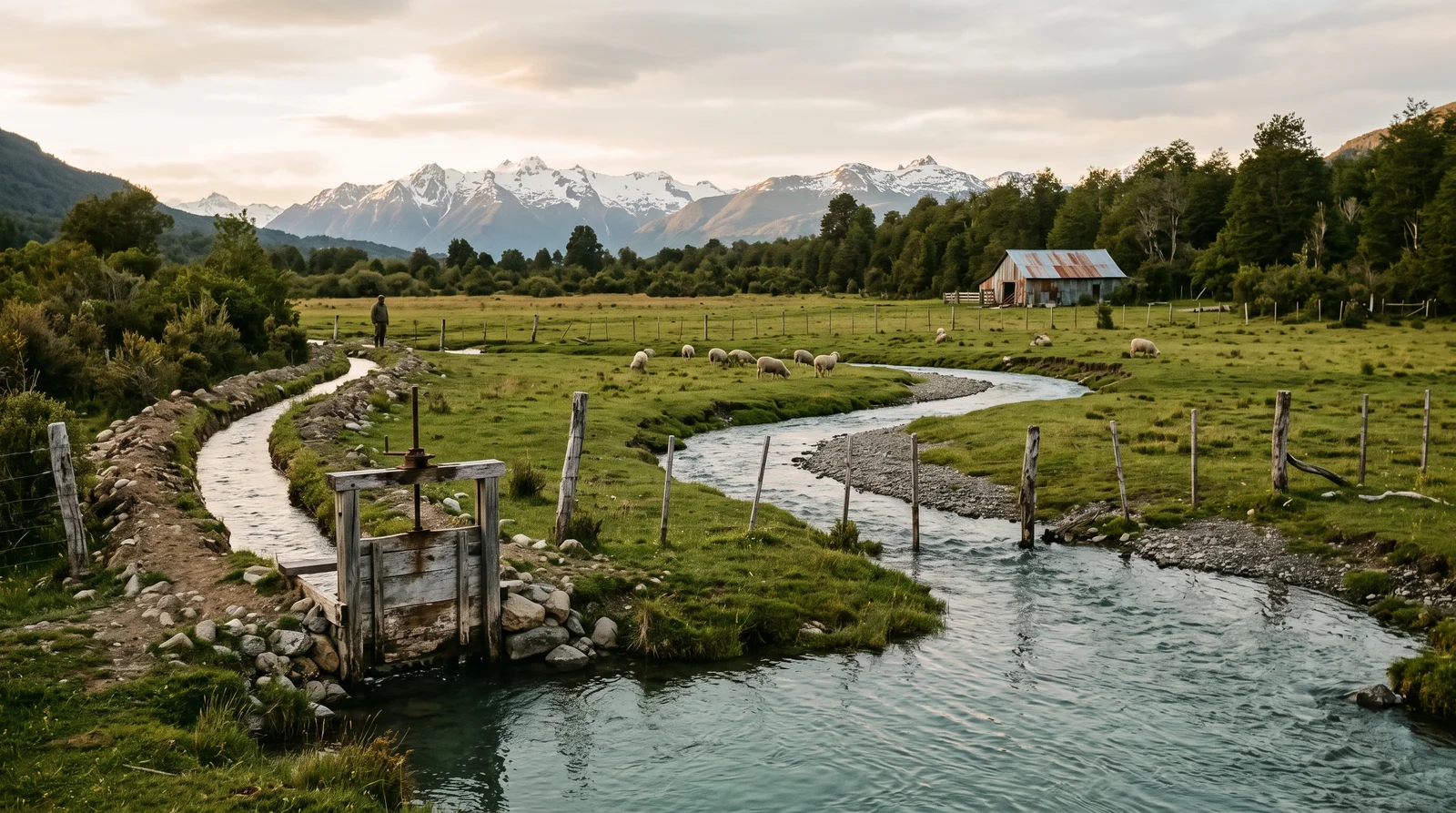 Built works are what prove effective use. See farms for sale near Coyhaique.
Aysen tops the national non-use patent list
Every January 15, the DGA publishes in the Diario Oficial the list of rights subject to the patente por no uso, the annual fee charged to holders who are not using their water, or are using only part of it. The point is to make hoarding expensive.
The 2026 process covers 5,432 water rights owing roughly 397.3 billion pesos in total, split between 2,977 consumptive rights (about 314.5 billion pesos) and 2,455 non-consumptive rights (about 82.9 billion pesos). Payment runs through the Tesoreria General de la Republica, with the 2026 deadline set at March 31.
And the single largest regional bill in the country belongs to the Aysen Region: about 128.5 billion pesos, more than any other region in Chile. La Araucania has more individual rights on the list; Aysen has the money.
Numbers That Matter: Aysen carries the highest non-use water patent bill in Chile, roughly 128.5 billion pesos in 2026. That is not because Aysen wastes water. It is because Aysen’s rivers carry enormous non-consumptive flows that were granted for dams that were never built.
That last point deserves unpacking, because it explains the whole anomaly. Aysen’s rivers are among the most powerful in the country, and during the hydroelectric boom huge non-consumptive rights were constituted on them. The most famous case was HidroAysen, the dam project on the Baker and Pascua rivers that was finally abandoned in 2017, with the sponsors renouncing the associated water rights. Non-consumptive rights are measured in enormous flows, so even a modest per-litre patent produces a spectacular total.
What this means for you as a buyer of a house, a parcel or a small farm: the giant numbers in the headlines are not your world. But the mechanism absolutely is. If the right attached to the land you are buying is sitting unused, it is accruing a patent, and the amounts escalate the longer the right stays idle. Sustained non-payment leads to judicial collection and, ultimately, the right being auctioned off. You do not want to inherit that.
April 6, 2027: the deadline that deletes water rights
Here is the single most time-sensitive thing in this guide.
Older water rights in Chile were often granted, used for generations, and never properly inscribed. Ley 21.435 said: register them, or lose them. That deadline was extended twice, most recently by Ley 21.727, and now falls on April 6, 2027. Rights not inscribed at the Conservador de Bienes Raices and registered in the Catastro Publico de Aguas by that date face caducidad. Not a fine. Expiry.
There is a bill in Congress proposing to push the deadline out to 2030, and given the history it may well pass. Plan as if it will not. A bill is not a law, and you are buying a property this year.
For rural properties in Aysen this is not a theoretical risk. Plenty of campos here have been worked by the same family since the colonisation era, with water use that everyone locally accepts and no paperwork anyone has looked at since the 1970s. Those uses can still be regularized through the DGA, which the reform put in charge of the procedure instead of the courts. But the window is closing, and regularization takes months.
Important: If the seller’s water right is not yet inscribed, do not close and sort it out later. Make regularization a condition of the promesa de compraventa, with the seller paying and a deadline attached. After April 2027 there may be nothing left to regularize.
Do you even need a water right?
Sometimes, refreshingly, no.
Article 56 of the Water Code allows anyone to dig a well on their own land for drinking and domestic subsistence use without holding a water right. The 2022 reform tightened this: it added the word “subsistence,” and it limited the volume to whatever the DGA determines for each basin, strictly for household use.
So if you are buying a cabin on two hectares and you want a well for the kitchen, the shower and the vegetable patch, you are very likely covered by Article 56 and do not need to buy a right. If you want to irrigate five hectares of pasture, run a fish-farming operation, supply a twelve-cabin lodge, or generate power, you need a proper derecho de aprovechamiento. The line is subsistence versus production, and it is not a line you want to guess at with a lawyer’s-fee-sized project on the other side.
 Water due diligence is a paperwork job, not a walk down to the river. Questions? Get in touch.
Seven checks before you sign
Run these in order. Your lawyer does the heavy lifting, but you should know what you are paying them to find.
1. Get the right’s own title certificate. Ask the Conservador de Bienes Raices for a copia con vigencia of the water right’s inscription, not just the land’s. It should state the flow (litres per second), the source, the point of capture, and every classification discussed above.
2. Confirm it is in the Catastro Publico de Aguas. Inscription at the Conservador is step one; registration in the CPA is step two, and it is mandatory. You can cross-check against the DGA’s register of constituted rights.
3. Check the non-use patent lists. The DGA publishes them year by year. If the right appears, ask why, ask whether the patents were paid, and check for any collection proceeding. Unpaid patents follow the right, not the seller’s goodwill.
4. Verify the works exist. Extinction for non-use is about built infrastructure: the intake, the channel, the pump, the return point. Walk the property and look at them. Photograph them. A right on paper with no bocatoma on the ground is a right on a five-year fuse.
5. Check where the point of capture actually is. It is common for the legal extraction point to sit on a neighbour’s land, which means you need a servidumbre de acueducto (an easement) properly constituted and registered. Verbal arrangements between neighbours who have known each other for forty years do not survive a change of owner.
6. Look for encumbrances. Water rights can be mortgaged, attached, or subject to litigation entirely independently of the land. The certificate of gravamenes y prohibiciones for the water right is a separate document from the one for the property.
7. Name the right in the contract. Explicitly, with its inscription details, in both the promesa and the escritura. This is where most transfers fail, and it is the cheapest thing on this list to get right.
Pro Tip: Ask the seller for the last three years of patente por no uso receipts, or a DGA certificate confirming the right is not on the list. Either document tells you in thirty seconds what a title search takes three weeks to reveal.
What water is worth in Aysen
Aysen is the awkward case in Chilean water economics. Nationally, the story is scarcity: scarcity decrees covering large parts of the centre and north, a structural drought running for more than a decade, and water rights trading at prices that would make a Californian almond grower wince.
Here, water is abundant. Rain, snowmelt, glacial rivers, and some of the largest freshwater bodies on the continent. Which means, counter-intuitively, that a consumptive right in Aysen usually trades at a fraction of what the same flow would fetch in the Maule or Coquimbo.
That has two consequences for buyers. First, do not pay a central-Chile premium for water on a Patagonian parcel. Second, and more importantly, the value of water here is not scarcity value, it is enabling value. It determines whether you can legally run a lodge, irrigate a pasture, stock a pond, or subdivide. A parcel without secure water is not cheap, it is constrained. Two neighbouring lots near Coyhaique at the same price per hectare can have completely different futures depending on who holds the paperwork.
This is also why water shows up in almost every other rural transaction question in the region: subdividing rural land under DL 3.516, regularizing a property without clean title, and the whole process of buying a farm in Patagonia as a foreigner all run into it eventually.
Foreign buyers: the rules are the same
Good news, and it is genuinely simple. A derecho de aprovechamiento is an ordinary real right, and Chile does not impose nationality restrictions on holding one. If you can buy the land, you can hold the water. There is no separate permit, no ownership cap, no special approval.
You will need a Chilean RUT to appear in the registries, and if you buy through a Chilean company (an SpA is common) the right goes in the company’s name alongside the property. The only geographic wrinkle is the general border-zone rule that applies to land, not to water specifically.
The practical asymmetry is not legal, it is informational. A Chilean farmer knows to ask about the derecho de aprovechamiento before asking about the fencing. A foreign buyer, arriving from a country where riparian rights come attached to the riverbank, often does not know the question exists. Now you do.
Frequently Asked Questions
Can I buy a water right separately from the land?
Yes. Water rights are freely tradeable assets and are regularly bought and sold independently of any property. In practice this is how buyers fix a parcel that has good land and no water: they acquire a right from a neighbouring holder, then apply to the DGA to change the point of capture if needed. That change is a formal procedure with technical review, not a paperwork swap, so budget time for it.
What happens to my water right during a scarcity decree?
A scarcity decree gives the DGA temporary powers to redistribute water in the affected area, and under the 2022 reform human consumption and sanitation take priority over productive uses. Your right is not cancelled, but the flow you actually receive can be reduced for the duration. Aysen is not among the chronically affected zones, which is one of the region’s quiet structural advantages.
Does a lake or river frontage give me any water rights at all?
No. Chile does not follow the riparian doctrine used in much of Europe and North America. Owning the bank of a river or the shore of a lake gives you access and views, and it gives you nothing in terms of a legal right to extract water. Frontage and rights are separate questions and must be verified separately.
Can the DGA reject an application for a new water right in Aysen?
Yes, and it does. Applications are assessed against the physical availability of water in the source, the ecological flow that must be maintained, and third-party rights already granted. The reform strengthened the environmental grounds for refusal. Abundance in the region does not guarantee approval for a specific point on a specific river.
How long does it take to transfer a water right at closing?
Once the right is properly inscribed and current, transferring it alongside a property adds relatively little time: it moves through the same escritura and the same Conservador, and typically registers within a few weeks of the deed. The delays come from rights that are unregistered, disputed, or need regularization first, which can take many months.
Who is responsible for unpaid non-use patents after I buy?
The obligation attaches to the water right itself, so a new holder inherits the exposure, including the risk that a collection proceeding already underway ends in the right being auctioned. This is why checking the patent lists and asking for receipts belongs in due diligence rather than in a post-closing surprise.
Do I need a water right to build a small hydro generator for my own cabin?
Yes. Generating power is a non-consumptive use, and it requires its own non-consumptive right even at micro scale for a single household. Article 56’s domestic exception covers drinking and subsistence household use from a well on your own land, not diverting a watercourse to run a turbine.
Interested in buying land in Patagonia?
We connect buyers with the best opportunities in Chile's Aysen Region. Tell us what you're looking for and we'll help you find it.
No commitment. Your information is kept confidential.

Written by
Nicolas GorroñoFounder & Editor
Founder of Patagonia Properties. Grew up in Coyhaique, lived in Australia, and is now back in Patagonia full-time. SEO and digital marketing specialist.
LinkedIn