Why Aysen Land Is Still Undervalued Compared to Argentine Patagonia
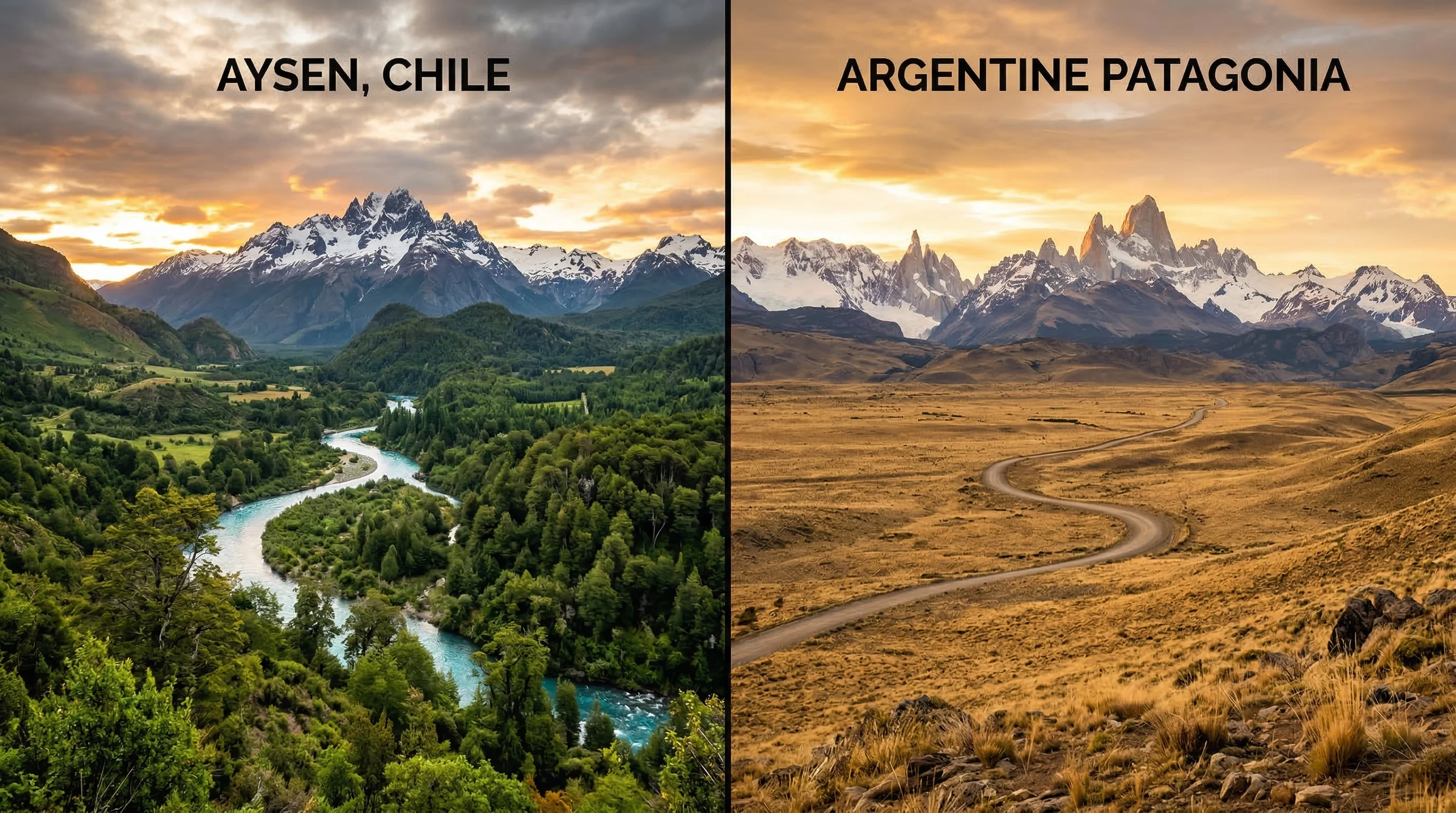
TL;DR: Comparable land in Aysen, Chile costs 60% to 90% less than equivalent plots in Argentine Patagonia (Bariloche, El Bolson, San Martin de los Andes). The gap stems from Argentina’s more developed tourism infrastructure and proximity to Buenos Aires, but Chile offers stronger property rights, currency stability, and a more predictable legal framework. As Aysen’s infrastructure improves and the Carretera Austral gains international recognition, the current pricing gap looks increasingly hard to justify.
Chilean and Argentine Patagonia share the same glaciers, the same ancient forests, and the same turquoise lakes. Cross the border at Paso Coihaique or Paso Huemules and the landscape barely changes. But the price tags are dramatically different. A 10-hectare parcel with lake views near Bariloche might cost $50,000 to $150,000 USD. A comparable parcel in the Aysen Region of Chile, with similar lake frontage and mountain backdrop, often sells for $6,000 to $32,000 USD.
This article breaks down why that gap exists, whether it is justified, and what it means for buyers looking at Patagonian land in 2026.
The price gap: Aysen vs. Argentine Patagonia
Let’s start with the numbers. These ranges reflect asking prices for rural and semi-rural land in 2025-2026 across multiple listing platforms and local agencies.
| Factor | Aysen, Chile | Argentine Patagonia (Lake District) |
|---|---|---|
| General land prices | $600 to $3,200 per acre | $5,000 to $15,000+ per acre |
| Remote sectors (per m²) | $2 to $8 USD | $15 to $40 USD |
| Lakefront/river-access premium | 50% to 300% above base | 100% to 500% above base |
| Lakefront price range | $1,800 to $10,000 per acre | $10,000 to $50,000+ per acre |
| Typical parcel sizes | 5 to 100+ hectares | 1 to 20 hectares |
The pattern is consistent across property types. Whether you compare raw parcels, improved land with basic infrastructure, or lakefront lots, Aysen prices run at a fraction of what buyers pay on the Argentine side.
For more detail on Aysen pricing trends specifically, see our analysis of land prices in Aysen.
Why does the gap exist?
The price difference is not random. Several factors explain why Argentine Patagonia commands higher prices.
Argentina’s Lake District has a 100-year head start in tourism
Bariloche has been a major tourist destination since the 1930s. San Martin de los Andes and Villa La Angostura developed significant tourism infrastructure in the decades that followed. These towns have international airports with direct flights from Buenos Aires, established hotel chains, ski resorts, and year-round tourism economies.
Aysen, by contrast, is still emerging. Coyhaique’s airport (Balmaceda, BBA) has limited commercial service. The Carretera Austral, while increasingly famous, remains partly unpaved. Tourism numbers are growing but start from a much smaller base.
Proximity to major population centers
Buenos Aires (population 15 million) is a 2-hour flight from Bariloche. Santiago (population 7 million) is roughly a 2.5-hour flight from Balmaceda, but with fewer daily connections. The Argentine Lake District benefits from a larger domestic market with easier access.
Established land market and speculation
Argentine Patagonia has an active secondary market for land. Properties change hands more frequently, creating a self-reinforcing cycle of rising prices. Aysen’s land market is thinner, with fewer transactions and less price discovery.
Why the gap is narrowing
While the historical reasons for the price difference are real, several structural factors are shifting the equation in Chile’s favor.
Stronger property rights
Chile provides the same property rights to foreigners as to Chilean citizens. There are no ownership quotas, no special permissions required (outside border zones, which have a straightforward authorization process), and no restrictions on profit repatriation.
Argentina has imposed currency controls, capital restrictions, and changing rules around dollar-denominated transactions. The peso has been deeply unstable, with inflation exceeding 100% in recent years. For foreign investors, getting money into and out of Argentine real estate has become significantly more complicated.
Property registration in Chile goes through the Conservador de Bienes Raices, a public registry system backed by an independent judiciary. Title certainty is high. Argentina also has registries, but the regulatory environment around foreign transactions has added layers of complexity.
Macroeconomic stability
Chile’s economy projects 2.2% GDP growth for 2026 with stable inflation targeting by an independent central bank. The country has 55 bilateral investment treaties and 34 free trade agreements, making it one of the most open economies in Latin America.
Chile’s new pro-business president has signaled deregulation and investor-friendly policies, further strengthening the investment thesis.
Argentina’s economic trajectory has been different. While the current administration has made strides toward fiscal balance, the country still carries the weight of years of capital controls, currency devaluation, and policy unpredictability. Investors price this risk into land values, but paradoxically it has also inflated Argentine land prices in dollar terms as locals use real estate as a store of value against peso depreciation.
Aysen’s infrastructure is improving rapidly
The Carretera Austral is becoming a world-class adventure travel route, drawing increasing international attention. Road improvements, new airports, expanded utilities, and better telecommunications are gradually closing the infrastructure gap.
The Aysen Region also benefits from regional tax incentives valid until 2035, which reduce income taxes and provide credits for businesses operating in the region. These incentives exist specifically because the Chilean government wants to drive development southward.
Nature-based tourism is booming
Global demand for remote, pristine natural destinations has surged since the pandemic. Aysen, with its intact ecosystems, near-zero light pollution, and vast unpopulated landscapes, fits this trend perfectly. The region’s tourism numbers have grown steadily, and the type of tourism is shifting toward higher-value experiential travel (fly fishing, trekking, wildlife observation) rather than mass tourism.
Being fair: where Argentina still wins
A balanced comparison requires acknowledging Argentina’s genuine advantages.
More developed tourism infrastructure. Bariloche has an international airport with direct flights from multiple Argentine cities and some international routes. It has a developed hospitality industry, ski resorts, and a well-established brand. Aysen is years behind in this regard.
Larger domestic market. Argentina’s population (46 million) is more than double Chile’s (19 million), providing a bigger pool of domestic tourists and buyers.
Established community and services. Towns like Bariloche and San Martin de los Andes have hospitals, international schools, shopping, and cultural amenities that Aysen’s smaller towns are still developing.
Brand recognition. “Bariloche” and “Patagonia Argentina” carry global brand recognition. Aysen is still building its international profile.
These are real advantages. But the question for land buyers is: do they justify prices that are 3x to 10x higher for comparable natural attributes?
What this means for buyers in 2026
The value gap between Aysen and Argentine Patagonia creates a specific opportunity. Buyers who prioritize legal certainty, economic stability, and lower entry prices can acquire land in Aysen at a fraction of the Argentine equivalent.
For a comprehensive guide to the buying process, see our article on buying land in Patagonia in 2026.
Key considerations:
- Entry price: A 10-hectare parcel in Aysen with forest, water access, and mountain views might cost $10,000 to $25,000 USD. The equivalent in the Argentine Lake District starts at $50,000 and often exceeds $100,000.
- Holding costs: Chilean property taxes (contribuciones) on rural land in Aysen are minimal, often under $100 USD per year. Regional tax benefits provide additional relief.
- Exit strategy: As Aysen develops, land values should appreciate. The question is timing, not direction. Infrastructure improvements, growing tourism, and increasing international awareness all point toward rising prices.
- Legal simplicity: Buying as a foreigner in Chile requires a RUT (tax ID), which is straightforward to obtain. The transaction process is notarized and registered, with clear title.
For foreign buyers specifically, our guide to buying property in Chile as a foreigner covers the process step by step.
Frequently asked questions
Can foreigners buy land in both Chile and Argentina?
Yes, but the process differs significantly. In Chile, foreigners have the same property rights as citizens. You get a RUT (tax number), sign before a notary, and register the title. In Argentina, foreigners can also buy, but the “Ley de Tierras” limits foreign ownership of rural land to 15% of productive land per province, with a cap of 1,000 hectares per individual in certain zones. Currency controls also complicate dollar-based transactions in Argentina.
Is Aysen land cheap because something is wrong with it?
No. Aysen land is priced lower primarily because of less developed infrastructure and lower market visibility compared to Argentine Patagonia. The underlying natural assets (water, forests, mountains, clean air) are equivalent or superior. Chile’s property rights framework is actually stronger than Argentina’s for foreign buyers. The price gap reflects a development timeline difference, not a quality difference.
Will Aysen land prices catch up to Argentine levels?
Full parity is unlikely in the near term because Bariloche and the Argentine Lake District have decades of tourism infrastructure and brand recognition that Aysen is still building. However, significant appreciation is probable as infrastructure improves, tourism grows, and more international buyers discover the region. The current gap of 60% to 90% is difficult to sustain as information becomes more accessible and the Carretera Austral gains global recognition.
What are the risks of buying land in Aysen?
The main risks are: slow appreciation if infrastructure development stalls, limited liquidity (fewer buyers in the secondary market compared to Argentina), access challenges in winter months for remote parcels, and potential regulatory changes (though Chile’s track record on property rights is strong). For border-zone properties (within 10 km of the Argentine border), you need authorization from the Ministry of Defense, which adds time but is routinely granted. See our guide on investing in Patagonia for a full risk assessment.
The bottom line
Aysen and Argentine Patagonia share the same spectacular natural landscape. But they operate in very different economic and legal environments. Chile offers stronger property rights, a more stable currency, clearer regulations for foreign buyers, and land prices that are a fraction of what comparable Argentine plots command.
The price gap exists for identifiable reasons (infrastructure maturity, market size, brand recognition) but those reasons are eroding as Aysen develops. For buyers who can tolerate a longer time horizon and value legal certainty over immediate convenience, Aysen represents one of the clearest value opportunities in South American real estate.
Interested in buying land in Patagonia?
We connect buyers with the best opportunities in Chile's Aysen Region. Tell us what you're looking for and we'll help you find it.
No commitment. Your information is kept confidential.

Written by
Nicolas GorroñoFounder & Editor
Founder of Patagonia Properties. Grew up in Coyhaique, lived in Australia, and is now back in Patagonia full-time. SEO and digital marketing specialist.
LinkedIn