Why Freshwater-Rich Patagonian Land Is the Investment of the Decade
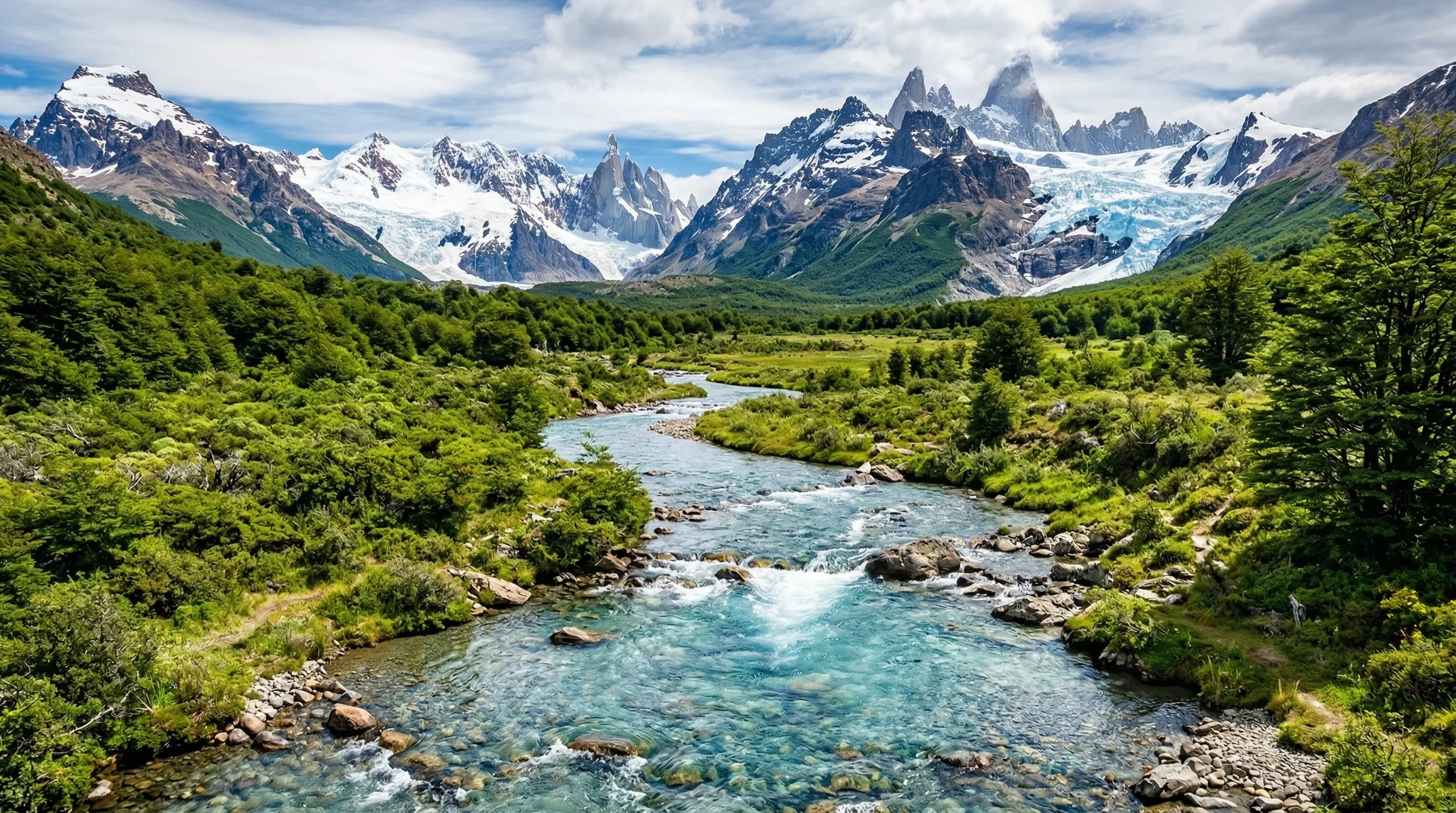
TL;DR: Chile is in the grip of a megadrought that has lasted since 2010, the longest in 1,000 years. Santiago’s rainfall has dropped 35% below historical averages. Meanwhile, the Aysen Region receives 3,000mm+ of rain annually and holds over 75% of Chile’s freshwater volume. Globally, land with reliable water access commands a premium of roughly 50% over comparable dry parcels. Three properties currently listed in Aysen offer distinct freshwater stories: fjord and glacier access, freshwater sources in conservation fjords, and a three-river confluence with lake frontage.
Chile has a water problem. Not the kind that makes headlines for a season and then fades. The kind that reshapes how an entire country thinks about land, agriculture, and long-term habitability. The central zone, home to roughly 70% of the population, is running dry. And that reality is creating an investment thesis that points directly south, to one of the most water-rich regions on the planet.
This article connects the numbers: Chile’s accelerating water crisis, the measurable premium that freshwater access adds to land values worldwide, the legal framework governing water rights after the 2022 reform, and the specific properties in Aysen that sit at the intersection of scarcity and abundance.
Chile’s water crisis in numbers
Chile’s megadrought began in 2010 and has not ended. It is the longest sustained dry period in at least 1,000 years, according to paleoclimatic reconstructions published by the Center for Climate and Resilience Research (CR2) at the Universidad de Chile.
The numbers paint a stark picture:
- Santiago rainfall: Currently averaging around 190mm per year, a 35% deficit compared to the historical average of approximately 300mm
- Groundwater extraction nationally: From 498 cubic hectometers (hm3) to 8,883 hm3 over four decades, a 17-fold increase as surface water has declined
- Agricultural impact: The Coquimbo and Valparaiso regions have lost over 30% of irrigated agricultural land since 2010
- Reservoir levels: Central Chile’s reservoirs have operated below 50% capacity for most of the past decade
The core number: Chile’s groundwater extraction has increased 17x over four decades, from 498 hm3 to 8,883 hm3. That rate of drawdown is not sustainable. When aquifers deplete, they do not refill on human timescales.
The megadrought is not a statistical anomaly. Climate models project continued aridification of central Chile through the end of the century, with rainfall declines of 20% to 40% in the Santiago-Valparaiso corridor by 2050. The country’s water future is being rewritten, and the new map has a clear geographic winner.
Meanwhile in Aysen…
While central Chile dries out, the Aysen Region operates on a completely different hydrological reality. The numbers are almost hard to believe if you have spent time in Santiago:
- Annual rainfall: 3,000mm+ across most of the region, rising to 4,000mm+ in the Queulat area near Puyuhuapi
- Share of national freshwater: Aysen and the regions south of it hold over 75% of Chile’s total freshwater volume
- Glaciers: Two-thirds of Latin America’s glacial ice is in Chile, concentrated in Patagonia’s Northern and Southern Ice Fields
- Rivers: The Baker, Cisnes, Palena, and Simpson rivers rank among Chile’s highest-volume waterways, fed by both rainfall and glacial melt
- Lakes: Lake General Carrera (the largest in Chile at 1,850 km2) and dozens of smaller lakes provide massive freshwater storage
| Region | Annual Rainfall | Water Status |
|---|---|---|
| Atacama (north) | 25mm | Extreme scarcity, desalination required |
| Coquimbo | 100mm | Severe deficit, aquifer depletion |
| Santiago Metro | 190mm | 35% below historical average |
| Biobio (central-south) | 1,200mm | Moderate, declining trend |
| Aysen (south) | 3,000mm+ | Surplus, no extraction stress |
| Queulat/Puyuhuapi | 4,000mm+ | Among the wettest areas in South America |
The contrast is not subtle. Aysen receives 15 to 20 times the rainfall of Santiago and has essentially zero extraction stress on its aquifers. This is not a region where water will become scarce in any foreseeable scenario. It is a region where water is so abundant that managing excess runoff is more often the engineering challenge than finding supply.
The freshwater premium: what water access does to land values
Water scarcity is not a future risk for global land markets. It is already priced in. Multiple studies and market analyses across different geographies show a consistent pattern: land with reliable freshwater access commands a premium of approximately 50% over comparable parcels without it.
This premium manifests in several ways:
- Agricultural land: In water-stressed regions of the American West, irrigated farmland sells for 2x to 5x the price of dryland parcels of equivalent acreage and soil quality
- Residential waterfront: Properties on lakes and rivers consistently command 50% to 200% premiums over nearby non-waterfront land, even when the water has no agricultural utility
- Rural recreational land: Access to fishable rivers, swimmable lakes, or scenic water features adds measurable value that compounds as scarcity increases in surrounding regions
The mechanism is straightforward. Water access makes land more versatile: it supports agriculture, livestock, tourism, aquaculture, residential use, and conservation. Dry land supports fewer uses and carries more risk. As global freshwater becomes scarcer (the UN projects that 5.7 billion people will face water stress by 2050), the premium for water-rich land will widen, not narrow.
In Aysen specifically, this dynamic is already visible. Lakefront parcels on Lake General Carrera command 50% to 300% premiums over comparable lots without water frontage. Properties on the Baker or Simpson rivers follow similar patterns. Water access is not just an amenity in Patagonia. It is the primary differentiator of long-term value.
Water rights in Chile: what the 2022 reform changed
Chile’s legal framework for water is unusual by global standards. Water rights are entirely separate from land ownership. You can own a riverfront property and not own the right to extract water from that river. Understanding this system is essential for any land investment in Aysen.
How do water rights work in Chile?
Chile’s 1981 Water Code created a market-based system where water rights are granted by the DGA (Direccion General de Aguas) and registered at the Conservador de Bienes Raices. They function as independent property rights that can be bought, sold, leased, or mortgaged separately from the land.
Key points for buyers:
- Water rights must be explicitly transferred in the sale contract. They do not automatically transfer with the land
- Rights specify a volume (liters per second), a source (river, lake, or aquifer), and an extraction point
- Both consumptive rights (irrigation, domestic use) and non-consumptive rights (hydroelectric, aquaculture) exist
- Approximately 70% of registered water rights in Aysen are consumptive, tied to agricultural and residential use
- Verification requires checking both the Conservador de Bienes Raices and the DGA registry
For a complete walkthrough, see our detailed guide to water rights when selling land in Chile.
The 2022 Water Code reform introduced significant changes:
- Use-it-or-lose-it provisions: Rights unused for 5 to 10 years can now be extinguished by the DGA, ending speculative hoarding
- 30-year concessions: New rights are granted for 30-year renewable terms, no longer in perpetuity
- Priority system: Human consumption takes top priority, followed by food production and environmental flows
- Registration mandate: All rights must be recorded in the DGA’s Public Water Registry
For investors, the reform actually strengthens the investment case for properties with active, registered water rights. The new scarcity framework makes properly documented rights more valuable, not less, because speculative hoarding is being eliminated from the supply side.
Patagonia as climate refuge
The freshwater story connects to a broader pattern. Patagonia is not just water-rich. It is emerging as one of the planet’s most significant climate refugia.
What is climate refugia?
Climate refugia are geographic areas that remain relatively buffered from the worst effects of climate change, maintaining stable temperature ranges, adequate precipitation, and functional ecosystems even as surrounding regions degrade. These areas are identified through modeling that overlays current climate projections with biological and hydrological data.
The concept is gaining traction in conservation science, land investment, and migration planning. Areas identified as refugia tend to see increased demand from both conservation organizations and private buyers seeking long-term habitability.
The data supporting Patagonia’s refugia status is substantial:
- TIME Magazine (2022) identified Patagonia as one of the world’s primary climate refuges based on temperature stability, water availability, and low population density
- Pew Charitable Trusts research found that 46 of 58 protected areas in Patagonia overlap with identified climate refugia zones
- Peer-reviewed studies estimate that 36% of the Patagonian steppe qualifies as Anthropocene refugia, meaning areas that will remain functional ecosystems through the current period of human-driven climate change
- Temperature projections for Aysen show warming of only 1 to 2 degrees Celsius by 2100 under moderate scenarios, compared to 3 to 5 degrees for central Chile
The investment implication is that demand for land in climate refugia will increase structurally over the coming decades. This is not a speculative bet on a single commodity or policy. It is a position aligned with the physical realities of a warming planet.
Three properties, three water stories
The investment thesis is abstract until you look at specific parcels. Three current listings in the Aysen Region illustrate different ways that freshwater access creates value.
Isla Patagonia: fjord and glacier water
Located in the fjords near Puerto Chacabuco, Isla Patagonia offers parcels with direct fjord frontage and access to glacier-fed freshwater sources. The fjord system provides both the water itself and the dramatic landscape context that drives tourism value.
The water story here is about volume and permanence. Glacier-fed systems provide year-round flow even during dry seasons (which, in this part of Aysen, still deliver more rain than Santiago sees in a year). The fjord setting also provides natural protection from wind exposure, creating microclimates that support vegetation and habitation.
Santuario Quitralco: freshwater in a conservation fjord
Santuario Quitralco sits in a fjord with multiple freshwater sources, combining conservation value with practical water access. The “santuario” (sanctuary) designation reflects the area’s ecological integrity: intact native forest, clean waterways, and minimal human impact.
For investors focused on conservation-linked appreciation (a growing segment globally), Quitralco represents the intersection of environmental value and water security. Properties in designated conservation areas with verified freshwater access are a finite resource that cannot be replicated.
Fundo Risopatron: three rivers and a lake
Fundo Risopatron near Puyuhuapi may have the most compelling freshwater profile of the three. It sits at the confluence of three rivers (the Palena, Risopatron, and Dinamarca) with additional frontage on Lake Risopatron. The Queulat area where it is located receives 4,000mm+ of annual rainfall.
Three river systems plus lake access plus 4,000mm of annual rainfall creates water redundancy that is virtually impossible to find at this price point anywhere else in the world. For agricultural, aquaculture, or tourism use, the water infrastructure is built by nature.
The investment case
The core thesis is simple: freshwater is becoming scarcer globally while Aysen has more than it could ever use. Properties with documented water access in Aysen sit at the intersection of a depreciating global supply and a stable local abundance.
Several factors support the case for near-term entry:
- Tax incentives: Aysen’s extreme zone benefits remain valid until 2035, providing a nine-year runway of favorable fiscal treatment. See our detailed breakdown of Aysen tax benefits
- Price floor: At $600 to $3,200 per acre, Aysen land remains among the cheapest in the Southern Hemisphere for comparable quality and water access
- Infrastructure momentum: Ongoing Carretera Austral improvements, fiber optic expansion, and airport upgrades are steadily reducing the remoteness discount
- Climate migration: Net positive migration into Aysen (confirmed by the 2024 Census) is creating sustained demand for land and housing
- Conservation demand: International conservation organizations are increasingly active in Patagonia, adding another buyer category to the demand side
The scarcity math favors patience. Global freshwater per capita has declined roughly 20% since 2000 and will continue declining. Aysen’s water supply is not declining. The gap between these two trendlines is the investment.
Frequently asked questions
Do water rights transfer automatically when I buy land in Aysen?
No. Water rights in Chile are legally separate from land ownership. They must be explicitly included in the sale contract and transferred through a separate registration at the Conservador de Bienes Raices. Always verify water rights status before purchasing. Our water rights guide covers the full verification and transfer process.
How much more is land with water access worth in Aysen?
In the Aysen Region, lakefront and riverfront parcels typically command premiums of 50% to 300% over comparable lots without water frontage. The premium varies by water type (lake frontage tends to command higher premiums than river access) and proximity to roads and towns. Globally, the premium for water-accessible land is widening as freshwater scarcity increases.
Is Patagonia really a climate refuge?
Multiple independent sources support this classification. TIME Magazine identified Patagonia as a global climate refuge in 2022. Pew Trust research found 46 of 58 Patagonian protected areas overlap with climate refugia. Peer-reviewed studies estimate 36% of the Patagonian steppe qualifies as Anthropocene refugia. The combination of stable temperatures, abundant freshwater, low population density, and intact ecosystems is difficult to replicate elsewhere.
What are the tax benefits of owning property in Aysen?
The Aysen Region benefits from Chile’s extreme zone legislation, which provides reduced tax rates, infrastructure subsidies, and economic incentives valid until 2035. Combined with Chile’s nationwide 8,000 UF capital gains exemption (approximately USD $300,000), property ownership in Aysen carries one of the lowest tax burdens in the country. See our complete guide to Aysen tax benefits for details.
Interested in buying land in Patagonia?
We connect buyers with the best opportunities in Chile's Aysen Region. Tell us what you're looking for and we'll help you find it.
No commitment. Your information is kept confidential.

Written by
Nicolas GorroñoFounder & Editor
Founder of Patagonia Properties. Grew up in Coyhaique, lived in Australia, and is now back in Patagonia full-time. SEO and digital marketing specialist.
LinkedIn