Fjord-Front Land: Chile's Patagonian Fjords vs Norway for Property Buyers
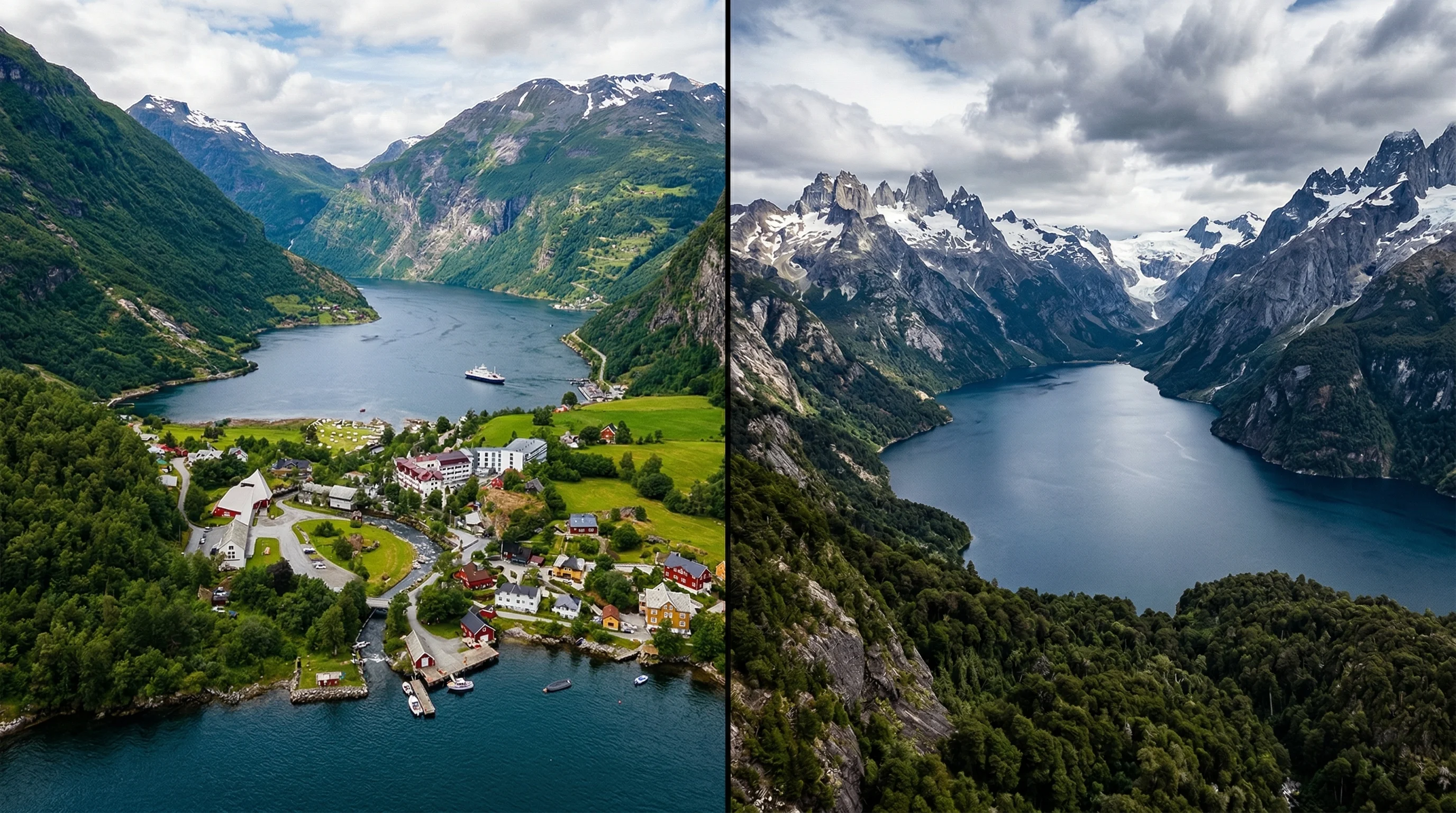
TL;DR: Norwegian fjord land averages
EUR 192,000 per hectare ($233,000 USD) in western counties like Vestland and Rogaland. Chilean fjord land at Santuario Quitralco on the Quitralco Fjord sells for 309 UF per hectare (~$11,000 USD). That is a 21:1 price ratio for landscapes that are geologically comparable. Chile has roughly 400 fjords, most with zero private development. Norway has ~1,190 fjords backed by 150+ years of tourism infrastructure. For buyers seeking fjord-front land, Chilean Patagonia represents one of the last frontier markets on earth.
When most people think “fjord property,” they think Norway. That association is so strong that many buyers never consider the alternative: Chile’s Patagonian coast, home to one of the densest fjord systems on the planet, with land prices that look like a rounding error compared to Scandinavia.
This article puts real numbers side by side. Norwegian fjord land versus Chilean fjord land versus New Zealand’s Fiordland. Prices, ownership rules, access logistics, climate, and the conservation tools available to buyers who want to protect what they purchase.
Two fjord countries, wildly different prices
The headline numbers tell the story.
Norwegian rural land in the fjord counties of Vestland and Rogaland averages approximately EUR 192,000 per hectare (~$233,000 USD). That figure reflects agricultural and rural parcels in Norway’s western fjord regions, drawn from Statistics Norway (SSB) land transaction data. Prime waterfront parcels with direct fjord frontage trade at substantial premiums above that average.
Chilean fjord land at Santuario Quitralco, a 20-lot development on the Quitralco Fjord in the Aysen Region, sells for 309 UF per hectare. At current UF values, that works out to roughly $11,000 USD per hectare.
The ratio: Norwegian fjord land costs approximately 21 times more than Chilean fjord land. Even accounting for differences in infrastructure and market maturity, the gap is striking.
Chile’s fjord system by the numbers
Chile’s coastline from Puerto Montt south to Cape Horn is one of the most fractured coastlines on earth. Glacial action over millions of years carved a labyrinth of channels, inlets, and fjords that rivals anything in Scandinavia.
The depth comparison: Chile’s Messier Channel reaches 1,358 meters deep. Norway’s famous Sognefjord, the deepest in Europe, reaches 1,308 meters. Chile’s fjord system is not a lesser version of Norway’s. By some measures, it is deeper.
Key figures for Chile’s fjord coast:
- ~400 fjords along the Patagonian coast (Region de Los Lagos through Magallanes)
- Coastline length: Chile’s total coastline exceeds 83,000 km when fjords and islands are included, making it one of the longest in the world
- Aysen Region alone: over 200 islands, dozens of fjords, and multiple ice fields feeding glacial waterways
- Population density: the Aysen Region has roughly 1.2 inhabitants per square kilometer, making it one of the least populated regions in South America
- Private development on fjords: virtually zero outside a handful of fishing villages and tourism lodges
The contrast with Norway is not geological. It is developmental. Norway’s fjords have been tourist destinations since the 1800s, with cruise ships, hotels, and established communities along every major inlet. Chile’s fjords remain largely wild, with most accessible only by boat or floatplane.
Why Norwegian fjords cost what they do
Norway’s fjord land prices reflect over a century of accumulated value:
Tourism maturity. The Norwegian fjords became a global tourism brand in the late 19th century. Geirangerfjord and Naeroyfjord are UNESCO World Heritage Sites. Cruise tourism alone brings over 300,000 passengers annually to Norwegian fjord ports. This tourism economy supports high land values.
Scarcity by regulation. Norway’s planning and building laws (Plan- og bygningsloven) strictly control development in fjord areas. Agricultural land enjoys strong protections. The combination of high demand and tight supply pushes prices upward.
Infrastructure. Roads, ferries, tunnels, airports, broadband, and municipal services reach virtually every inhabited fjord community. A buyer purchasing fjord land in Norway is buying into a fully built-out infrastructure system.
Domestic wealth. Norway’s GDP per capita exceeds $90,000 USD. Norwegian buyers compete with international buyers for a limited supply of waterfront properties, keeping prices elevated.
Why Chilean fjords are different
Chilean fjord land operates under a completely different set of conditions:
Marine-only access. Most Chilean fjords south of Chaiten have no road access. The Carretera Austral runs north-south through the Aysen Region but rarely reaches the coast. Getting to a fjord property typically means a boat ride from Puerto Chacabuco or Puerto Aysen. This limits the buyer pool but also protects the landscape.
Frontier market pricing. Aysen’s land market is thin. Transactions are infrequent, price discovery is limited, and international buyers represent a small fraction of activity. As we analyzed in our comparison of Aysen versus Argentine Patagonia, the region is underpriced relative to comparable landscapes elsewhere.
No tourism infrastructure. There are no cruise ships in the Quitralco Fjord. No hotels. No restaurants. This is raw, undeveloped coastline with temperate rainforest running to the waterline. For some buyers, that is exactly the point.
Full foreign ownership. Chile grants identical property rights to foreign and domestic buyers. There are no ownership caps, no special permits required for most Aysen properties, and no restrictions on resale or profit repatriation. Norway allows foreign ownership but layers on significant land-use restrictions.
Comparison table: Norway vs Chile vs New Zealand
New Zealand’s Fiordland is the third major fjord region globally, so it belongs in this comparison.
| Factor | Norway (Vestland/Rogaland) | Chile (Aysen Region) | New Zealand (Fiordland) |
|---|---|---|---|
| Price per hectare | ~$233,000 USD | ~$11,000 USD | Mostly unavailable (national park) |
| Number of fjords | ~1,190 | ~400 | 14 major fiords |
| Foreign ownership | Allowed, with land-use restrictions | Fully allowed, equal rights | Allowed via Overseas Investment Office approval |
| Road access | Most fjords road-accessible | Most fjords marine-only | Milford Sound road-accessible; rest are not |
| Climate | Mild maritime (Bergen: 1-15°C range) | Cool maritime (Aysen: 2-16°C range) | Cool maritime (Te Anau: 2-18°C range) |
| Tourism development | Fully mature (150+ years) | Minimal/none on fjords | Moderate (Milford Sound is major attraction) |
| Private land availability | Limited, regulated | Available in select developments | Almost none (95% is national park) |
| Conservation easements | Voluntary conservation agreements | DRC (Law 20,930, since 2016) | QEII National Trust covenants |
New Zealand’s Fiordland is effectively off the table for private buyers. Roughly 95% of the Fiordland region is national park land. The small amount of private land near Te Anau or Manapouri is not fjord-front in the way Norwegian or Chilean properties are.
Santuario Quitralco: what fjord land actually looks like
Santuario Quitralco is the most concrete example of what fjord-front ownership looks like in Chilean Patagonia today.
The development sits on the Quitralco Fjord, accessible by boat from Puerto Chacabuco (approximately 2 hours). It consists of 20 individual lots starting at 2 hectares each, priced at 309 UF per hectare (~$11,000 USD/ha). The total development includes over 20 hectares of shared ecological reserve.
What makes Quitralco distinctive:
- Hot springs. The area is known for its geothermal activity. Natural hot springs are located near the development, a feature that has historically driven premium valuations in comparable settings (think Iceland, Japan, or New Zealand’s Taupo zone).
- Valdivian temperate rainforest. The lots are covered in old-growth temperate rainforest, one of the most carbon-dense forest types on the planet.
- DRC conservation option. Buyers can register a Derecho Real de Conservacion on their lot, permanently protecting the land while retaining ownership.
- Marine wildlife. The Quitralco Fjord supports populations of dolphins, sea lions, and seasonal whale activity.
For buyers interested in the broader Puerto Aysen area, Isla Patagonia offers another fjord-front option near Puerto Chacabuco.
The conservation angle
One of the strongest differentiators for Chilean fjord land is the legal framework for conservation.
What is a Derecho Real de Conservacion (DRC)?
The Derecho Real de Conservacion (DRC) is a conservation easement established by Chilean Law 20,930, enacted in 2016. It allows a landowner to place a binding, transferable, and indivisible conservation restriction on their property. The restriction runs with the land, meaning it survives any future sale.
Key features of the DRC:
- Voluntary. The landowner chooses to create it.
- Perpetual or time-limited. The owner sets the duration.
- Transferable. It can be assigned to a conservation organization, a foundation, or another party.
- Indivisible. It cannot be partially removed from the property.
- Registered. It is recorded at the Conservador de Bienes Raices, giving it full legal force.
A DRC does not transfer ownership. The landowner retains title and can use the property within the terms of the easement. Typical DRC terms prohibit subdivision, logging, mining, and intensive construction while allowing low-impact habitation and ecotourism.
The conservation value of Chilean fjord land is not abstract. Valdivian temperate rainforest, the dominant ecosystem along Chile’s fjord coast, sequesters over 800 tons of CO2 per hectare in above-ground and below-ground biomass. This makes it one of the most carbon-dense forest types outside tropical rainforests.
For buyers motivated by conservation, a DRC-protected fjord lot combines permanent landscape preservation with personal use rights. It is a model that does not exist at this price point anywhere else in the world.
For more context on environmental considerations when purchasing land in Chile, see our guide on water rights and land transactions.
Is fjord land a good investment?
This is where buyers need to think carefully. Fjord land in Chile is not a conventional real estate investment with predictable rental yields or quick liquidity. It is a frontier asset with a specific risk-return profile.
Arguments for appreciation:
- Aysen land prices have shown steady upward trends as the Carretera Austral gains international visibility
- Chile’s macroeconomic stability (2.2% GDP growth projected for 2026, independent central bank, 55 bilateral investment treaties) provides a solid foundation
- Global fjord-front land is a genuinely finite resource. There will never be more fjords
- Conservation-oriented buyers (individuals, foundations, impact funds) represent a growing demand segment
- Tourism to Chilean Patagonia continues to grow year over year, gradually building the infrastructure that supports higher land values
Arguments for caution:
- Liquidity is low. Selling a fjord lot in Aysen is not like selling a condo in Santiago. The buyer pool is small and specialized
- Marine-only access adds cost and complexity to any use of the property
- There is no established rental market for remote fjord properties (yet)
- Climate conditions limit year-round use for most buyers
The honest assessment: fjord land in Chile is best suited for buyers with a long time horizon (10+ years), a genuine interest in conservation or personal use, and comfort with illiquidity. It is not a speculative flip. It is a position in one of the last undeveloped fjord coastlines on earth, at prices that reflect the current state of the market rather than the long-term scarcity of the asset.
Frequently asked questions
Can foreigners buy fjord land in Chile?
Yes. Chile grants identical property rights to foreign and domestic buyers. There are no special permits, ownership caps, or residency requirements for purchasing land in the Aysen Region. Some properties near the Argentine border fall within a designated border zone that requires authorization from the Direccion de Fronteras y Limites (DIFROL), but fjord-front properties on the Pacific coast generally do not fall within this zone.
How do you access fjord properties in Aysen?
Most fjord properties in Aysen are accessible only by boat. The typical route is to fly into Balmaceda airport (BBA), drive to Puerto Chacabuco or Puerto Aysen (approximately 80 km), and then take a boat to the fjord. Some properties can also be reached by floatplane. There are no roads to most fjord locations. This is a fundamental characteristic of the landscape, not a temporary infrastructure gap.
What is the climate like on Chilean fjords?
The Aysen fjord coast has a cool maritime climate. Average temperatures range from 2°C in winter to 16°C in summer. Annual rainfall is high, typically 2,500 to 4,000 mm depending on the specific location. The fjords are sheltered from the open Pacific, so conditions are calmer than the exposed outer coast. Snow is rare at sea level but common at higher elevations.
How does a DRC affect property resale value?
A DRC (Derecho Real de Conservacion) can affect resale value in both directions. It limits potential uses (no subdivision, no logging, no intensive development), which may reduce appeal for buyers seeking development potential. However, it can increase appeal for conservation-minded buyers, impact investors, and foundations seeking permanently protected land. Globally, conservation easements have not been shown to reduce property values in high-amenity natural settings. In many cases, the “forever wild” guarantee actually increases perceived value among the growing segment of buyers who prioritize environmental integrity.
Interested in buying land in Patagonia?
We connect buyers with the best opportunities in Chile's Aysen Region. Tell us what you're looking for and we'll help you find it.
No commitment. Your information is kept confidential.
Written by
Nicolas GorroñoFounder & Editor
Founder of Patagonia Properties. Grew up in Coyhaique, lived in Australia, and is now back in Patagonia full-time. SEO and digital marketing specialist.
LinkedIn