Conservation Land Investment in Chile: Buy Land and Protect It
TL;DR: Chile’s Derecho Real de Conservacion (Law 20,930) lets any landowner place a binding, transferable conservation restriction on their property. Combined with Valdivian rainforest that sequesters 800+ tons of CO2 per hectare and IPCC carbon price targets of $50 to $200 per ton by 2030, conservation land in Patagonia offers a rare combination of ecological impact and financial upside. Santuario Quitralco on the Quitralco Fjord represents one of the most accessible entry points at 309 UF per hectare (roughly $11,000 USD).
The pitch sounds almost too good: buy pristine forest, protect it legally, earn carbon credit income, and watch the land appreciate. Companies like The Real Eco State have built a business around exactly this claim, reporting US$25 million in sales across 6,000+ hectares to 650+ clients, with projected annual returns of 20%.
Those numbers deserve scrutiny. But the underlying framework is real, Chile’s conservation law is robust, the carbon market is growing, and the land is genuinely cheap compared to what it stores. This article breaks down what conservation land investment actually involves, what the law says, what the numbers look like, and where the risks hide.
What is conservation land investment?
The concept is straightforward: purchase land with significant ecological value (native forest, wetlands, riparian corridors), protect it through a legal instrument, and generate returns through a combination of land appreciation, carbon credit sales, and ecosystem service payments.
This is not a new idea. In the United States, conservation easements have existed since the 1960s and now cover over 40 million acres. The financial incentive there is primarily tax-driven: landowners receive income tax deductions of up to 50% of adjusted gross income, with a 15-year carryover period. That tax benefit alone has driven billions of dollars into conservation land.
Chile’s version is newer but structurally similar. The key difference: Chile’s mechanism was designed from the start to be transferable and to survive changes of ownership. In practice, this means conservation land in Chile can function as an investment asset, not just a tax strategy.
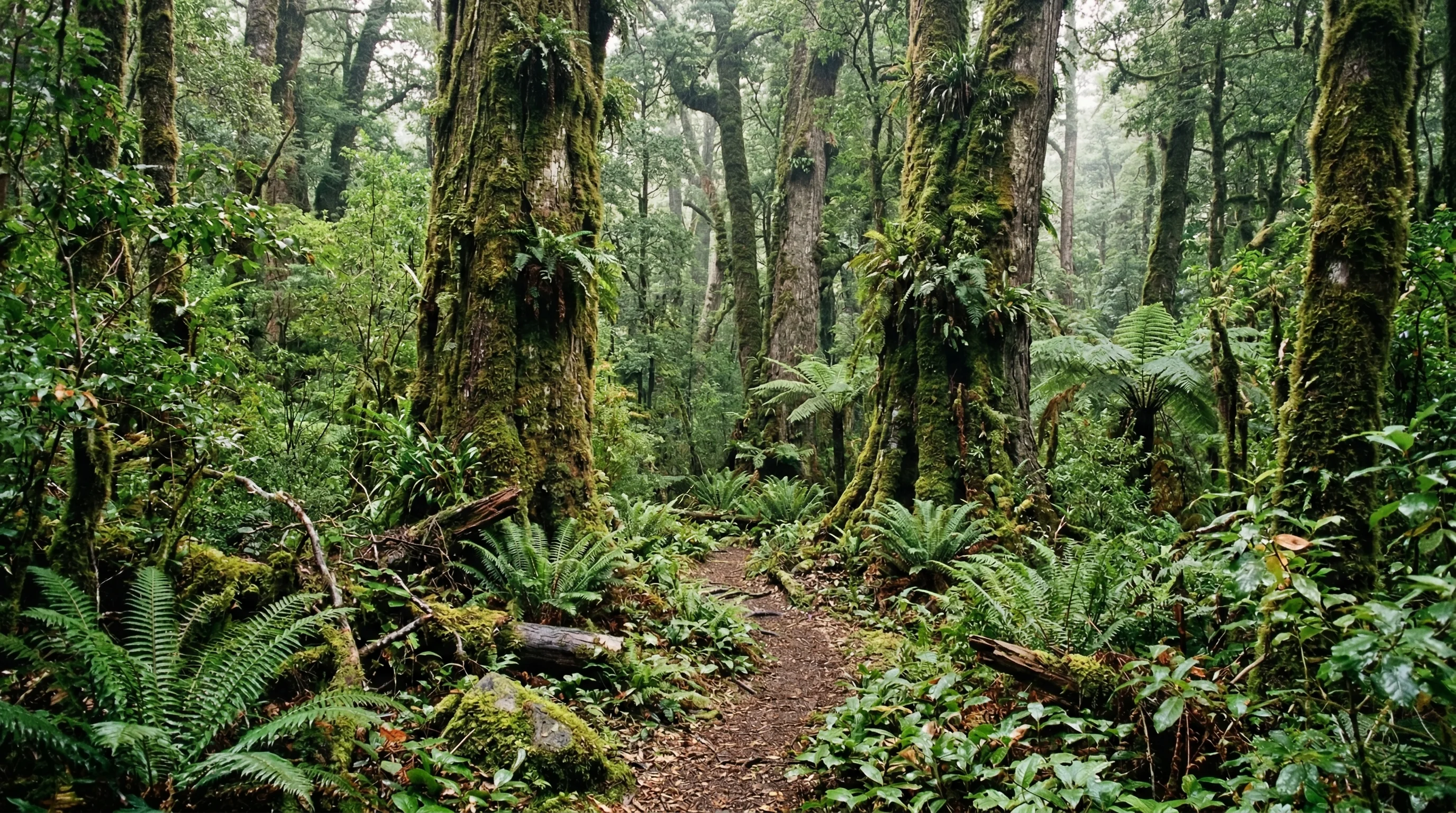
The appeal for Patagonia specifically comes down to biology. The Valdivian temperate rainforest, which covers much of coastal Aysen, is one of the most carbon-dense forest types on earth. Old-growth stands in this ecosystem store 800+ tons of CO2 per hectare, roughly 3 to 4 times what a typical tropical rainforest holds per unit area. That carbon density is the foundation of the financial case.
Chile’s Derecho Real de Conservacion (Law 20,930)
The Derecho Real de Conservacion (DRC) became law in June 2016. It creates a legal framework for placing binding conservation restrictions on private land. Understanding what the law actually says matters more than the marketing around it.
Core features of the DRC:
- Transferable: The conservation right can be sold, donated, or inherited. It is not locked to the original owner.
- Indivisible: You cannot split a DRC into pieces. It covers the entire designated area as a single unit.
- Runs with the land: The restriction survives any sale. Future owners are bound by it.
- Voluntary: Any landowner can create a DRC. It is not limited to NGOs, foundations, or government entities.
- Registered: The DRC must be inscribed at the Conservador de Bienes Raices, giving it the same legal weight as a property title.
- Flexible scope: The owner defines what activities are restricted. A DRC can prohibit logging while allowing low-impact tourism, for example.
The law was modeled on US conservation easements but adapted for Chilean property law. One critical difference: US easements are permanent by default, while Chilean DRCs can be created with a defined term (though permanent DRCs are also possible). Another difference: the US system provides direct tax deductions, while Chile’s DRC currently has no explicit income tax benefit.
How do I create a DRC on my land?
Creating a DRC requires a contract between the landowner and a “titular” (the entity that will hold and enforce the conservation right). The titular can be a municipality, a university, a foundation, or another qualified entity. The contract must specify the exact boundaries of the conservation area, the activities that are restricted, and the duration (if not permanent). The contract is then signed before a notary and inscribed at the Conservador de Bienes Raices. The process typically takes 2 to 4 months and costs between 50 and 150 UF in legal fees. No government approval is required beyond the registration.
How it works for individual buyers
A common misconception is that conservation land investment requires institutional-scale capital or NGO involvement. Under Chile’s DRC framework, any landowner can participate. You do not need to be a foundation, a corporation, or a Chilean citizen.
The typical process for an individual buyer:
- Purchase land with native forest or other ecological value
- Commission a baseline ecological assessment documenting the carbon stock, biodiversity, and conservation significance
- Create a DRC through a contract with a qualified titular entity
- Register the DRC at the Conservador de Bienes Raices
- Optionally pursue carbon credit certification through a standard like REDD+ or Verra’s VCS
- Hold the land, earning returns through carbon credits, land appreciation, or both
The DRC does not prevent you from using the land entirely. You can still build a cabin for personal use, develop low-impact ecotourism infrastructure, or allow scientific research access. What you cannot do (depending on the DRC terms) is log the forest, subdivide for residential development, or engage in extractive activities.
For buyers interested in the water rights implications of conservation land, our guide to water rights when selling land in Chile covers the legal framework. If your land falls near the Argentine border, border zone restrictions in Aysen may apply.
US conservation easements vs. Chile’s DRC
The comparison matters because the US system is the most developed conservation land market in the world, and many international buyers use it as their reference point.
| Feature | US Conservation Easement | Chile DRC (Law 20,930) |
|---|---|---|
| Year established | 1960s (codified 1980) | 2016 |
| Tax deduction | Up to 50% of AGI (25% for farmers), 15-year carryover | No direct income tax deduction (yet) |
| Property tax | Reduction varies by state | Exemption possible for conservation land |
| Duration | Permanent (by default) | Defined term or permanent |
| Transferable | Yes | Yes |
| Who can create | Any landowner | Any landowner |
| Enforcement | Land trust or government | Titular entity (municipality, university, foundation) |
| Typical cost to establish | $5,000 to $50,000+ | 50 to 150 UF ($1,800 to $5,400) |
| Market maturity | 40+ million acres protected | Emerging (hundreds of DRCs registered) |
The absence of a direct tax deduction in Chile is the most significant gap. In the US, a landowner who places a $500,000 conservation easement on their property can deduct that value from their income over 15 years. In Chile, the DRC itself does not generate a tax benefit. However, land classified for conservation use may qualify for property tax (contribuciones) exemptions at the municipal level. This is assessed case by case.
What are the tax benefits of conservation land in Chile?
Chile does not currently offer a direct income tax deduction for creating a DRC. However, there are two potential tax advantages. First, land designated for conservation may qualify for property tax exemptions under municipal assessment rules, reducing annual contribuciones to zero in some cases. Second, the Aysen region’s broader tax incentives (valid until 2035) apply to businesses operating in the region, which could include ecotourism ventures on conservation land. There is ongoing legislative discussion about introducing tax incentives specifically for DRC holders, but nothing has passed as of March 2026. The financial case in Chile currently rests more on land appreciation and carbon credits than on tax optimization.
The carbon credit angle
This is where the numbers get interesting, and where the most uncertainty lives.
The carbon density fact: Valdivian temperate rainforest in coastal Aysen stores 800+ tons of CO2 per hectare in standing biomass and soil carbon. That is 3 to 4 times the carbon density of a typical tropical rainforest. A single hectare of old-growth Valdivian forest, if verified and credited, represents a carbon asset worth $40,000 to $160,000 at IPCC target prices of $50 to $200 per ton by 2030.
Those headline numbers require heavy qualification.
What is actually creditable: You cannot sell carbon credits for carbon that is already stored. Carbon credits under standards like REDD+ (Reducing Emissions from Deforestation and Degradation) or Verra’s Verified Carbon Standard (VCS) are issued for avoided emissions or additional sequestration. This means you earn credits by proving that your forest would have been logged, degraded, or converted without your intervention, and that your conservation action prevented those emissions.
The verification process: REDD+ certification requires a baseline assessment, a monitoring plan, third-party validation, and ongoing verification. The cost for a small landowner (under 100 hectares) typically ranges from $20,000 to $50,000 for initial certification, with annual monitoring costs of $5,000 to $15,000. These costs make individual small-lot certification impractical. The viable path for small landowners is aggregation: pooling multiple properties into a single REDD+ project that shares certification costs.
Current vs. projected prices: Voluntary carbon market prices have been volatile. In 2024, forestry-based carbon credits traded between $5 and $30 per ton, far below the IPCC’s $50 to $200 target range. The gap between current market prices and what climate scientists say is necessary creates both opportunity and risk. If policy forces carbon prices upward (through compliance markets, border carbon adjustments, or corporate mandates), early holders of verified forest carbon could see significant returns. If voluntary markets remain fragmented and low-priced, the carbon income case weakens.
The math for a 2-hectare lot: At current voluntary market prices ($10 per ton) and assuming 5 tons per hectare per year in credited sequestration (a conservative estimate for young-growth Valdivian forest), a 2-hectare lot generates roughly $100 per year in carbon income. That is negligible. At $100 per ton (mid-range IPCC target), the same lot generates $1,000 per year. More meaningful, but still modest relative to the land cost. The carbon credit case is strongest for larger holdings (50+ hectares) where certification costs can be amortized and sequestration volumes are commercially significant.
The Real Eco State model
The Real Eco State is the most visible company operating in this space. Their model is worth examining because it illustrates both the potential and the risks of conservation land investment.
What they do: They acquire large tracts of native forest in southern Chile, subdivide them into lots (typically 1 to 5 hectares), and sell to international buyers with a conservation mandate. Buyers receive title to the land plus a DRC that restricts development to 5% of the lot area. The remaining 95 to 100% must remain as protected forest.
Their numbers: US$25 million in total sales, 6,000+ hectares under conservation, 650+ international clients. They claim annual returns of approximately 20%, driven by land appreciation and carbon credit potential.
The 20% return claim: This requires examination. If a buyer purchases a 2-hectare lot for $20,000 and the land appreciates 20% annually, the lot would be worth $100,000 in 8.5 years. That level of appreciation is possible in a rapidly developing market but is not guaranteed. Land in remote parts of Aysen does not have the liquidity or demand depth to support consistent 20% annual growth. Some lots in high-demand areas may exceed that figure. Others may appreciate slowly or not at all. Past performance data for specific lots is not publicly available.
What they get right: The DRC structure is legally sound. The conservation commitment is real and enforceable. The land genuinely contains high-value native forest. The aggregation model (pooling many small lots into a single conservation project) is the correct approach for carbon credit viability.
What to scrutinize: Projected returns based on carbon credit income that does not yet exist. Exit liquidity for small conservation lots. The gap between IPCC target prices and actual voluntary market prices. The cost basis when including legal fees, travel, and certification expenses.
Santuario Quitralco: conservation investment in practice
For buyers who want to see what this looks like on the ground, Santuario Quitralco offers a concrete reference point.
The development: 20 lots on the Quitralco Fjord, accessible only by sea. Each lot is a minimum of 2 hectares. The project includes a 20+ hectare ecological reserve held in common. Ancient Valdivian temperate rainforest covers the site, with freshwater sources running through the lots. Hot springs are located nearby, a natural feature that adds both recreational and tourism value.
The price: 309 UF per hectare, which translates to roughly $11,000 USD per hectare at current exchange rates. For comparison, fjord-front land in Norway costs $50,000 to $500,000+ per hectare. Comparable conservation-designated land in Costa Rica runs $15,000 to $40,000 per hectare. Quitralco is priced at the low end of global conservation land markets.
The conservation angle: Buyers have the option to establish a DRC on their lot. The existing ecological reserve provides a conservation buffer regardless of individual lot decisions. The marine-only access naturally limits development pressure: no one is building a shopping center on a fjord accessible only by boat.
What makes it distinctive: The combination of fjord frontage, ancient forest, hot springs, freshwater, and DRC eligibility in a single development is unusual. Most conservation land offerings are inland forest without water access. Quitralco’s coastal position adds both ecological diversity (marine and terrestrial ecosystems meeting) and potential tourism value.
The practical considerations: Marine-only access means higher logistics costs for any construction or improvement. There is no grid electricity (solar and micro-hydro are the options). Mobile coverage is limited. These constraints reduce the buyer pool but also protect against speculative development, which is precisely the point for conservation buyers.
Returns and risks
An honest assessment of conservation land investment in Chilean Patagonia needs to separate what is proven from what is projected.
What is proven:
- Land prices in Aysen have trended upward over the past decade, driven by tourism growth, infrastructure improvements, and increasing international interest
- Chile’s DRC framework is legally functional and has been used by hundreds of landowners since 2016
- Valdivian rainforest carbon density is scientifically documented at 800+ tons CO2 per hectare
- The Aysen region’s tax incentives are valid until 2035
What is projected (not proven):
- Carbon credit prices reaching $50 to $200 per ton by 2030
- 20% annual land appreciation sustained over multiple years
- Small-lot carbon credit certification becoming economically viable through aggregation
- Legislative introduction of tax benefits for DRC holders in Chile
Key risks:
- Liquidity: Conservation-restricted land has a smaller buyer pool than unrestricted land. Selling may take years.
- Carbon credit uncertainty: The voluntary carbon market is immature, volatile, and faces credibility challenges. Credits may be worth less than projected.
- Access costs: Marine-only or remote access properties carry ongoing logistics expenses that erode returns.
- Regulatory change: Conservation incentives depend on political will. A future government could weaken DRC enforcement or fail to introduce tax benefits.
- Verification costs: REDD+ certification for small holdings is expensive relative to the income it generates. Without aggregation, the math does not work for lots under 50 hectares.
Who is this for?
Conservation land investment is not for every buyer. The profile that makes sense:
The conservation-minded buyer: Someone who genuinely values protecting native forest and sees financial return as a secondary benefit. This buyer is satisfied if the land appreciates modestly and the forest remains intact. The DRC gives them legal assurance that their conservation intent survives even if they sell.
The impact investor: A buyer who allocates capital to environmental outcomes and accepts below-market liquidity in exchange for measurable ecological impact. Carbon credits, biodiversity metrics, and forest cover data provide the impact reporting this buyer needs.
The legacy buyer: Someone purchasing land as a multi-generational asset. The 50-year or 100-year view changes the risk calculus entirely. Over that timeframe, the probability that carbon markets mature, that Chile introduces conservation tax benefits, and that pristine Patagonian forest becomes dramatically scarcer all increase substantially.
Who should not buy: Anyone who needs liquidity within 5 years. Anyone whose financial plan depends on carbon credit income at prices that do not yet exist. Anyone who is not comfortable with marine-only or remote access logistics. Anyone who views conservation restrictions as a temporary inconvenience rather than the core purpose of the investment.
Frequently asked questions
Can a foreigner create a DRC on land in Chile?
Yes. Chile’s DRC law (Law 20,930) does not restrict participation by nationality. Any landowner, Chilean or foreign, can create a DRC on their property. The standard property purchase restrictions apply: foreign buyers in border zones (within a defined distance of the Argentine or Bolivian border) need authorization from the Ministry of National Defense. Parts of Aysen fall within this zone, so verify before purchasing. See our guide to border zone restrictions in Aysen for details.
How much does it cost to establish a DRC?
Legal fees for drafting and registering a DRC typically run between 50 and 150 UF ($1,800 to $5,400 USD). This covers the contract drafting, notarization, and inscription at the Conservador de Bienes Raices. The cost does not include the ecological baseline assessment (typically $2,000 to $5,000 for a small lot) or carbon credit certification ($20,000 to $50,000 for REDD+ or VCS verification, usually shared across multiple properties in an aggregation model).
Can I build on conservation land with a DRC?
It depends on the terms of the DRC. The landowner defines what activities are restricted when creating the DRC contract. Most conservation DRCs allow low-impact structures on a small percentage of the lot (typically 5% of total area). This means a cabin, a small ecotourism facility, or research infrastructure is usually permitted. Large-scale residential or commercial development is typically prohibited. The specific terms are negotiable at the time of DRC creation.
Are carbon credits from Chilean forest realistic income today?
At current voluntary market prices ($5 to $30 per ton), carbon credit income from a small conservation lot (2 to 5 hectares) is minimal: perhaps $50 to $300 per year. The income becomes meaningful only at scale (50+ hectares) or at higher carbon prices ($50+ per ton). The most realistic path for small landowners is to join an aggregated REDD+ project that pools multiple properties, sharing both the certification costs and the credit revenue. Several aggregation initiatives are in early stages in southern Chile, but none have achieved full REDD+ certification for small private lots as of March 2026.
Interested in buying land in Patagonia?
We connect buyers with the best opportunities in Chile's Aysen Region. Tell us what you're looking for and we'll help you find it.
No commitment. Your information is kept confidential.

Written by
Nicolas GorroñoFounder & Editor
Founder of Patagonia Properties. Grew up in Coyhaique, lived in Australia, and is now back in Patagonia full-time. SEO and digital marketing specialist.
LinkedIn